HESCO Bill July Unit Price 2026: Latest Rates, NEPRA Cut & Bill Calculation
Find out exactly how much HESCO charges per unit in July 2026, what changed under NEPRA’s quarterly tariff cut, and how to calculate your bill accurately.
Check Your HESCO Bill Now →- NEPRA cut the base electricity tariff by Rs 1.98 per unit, effective across June, July, and August 2026 billing cycles.
- Lifeline consumers (under 100 units/month) were excluded from this relief.
- HESCO bills still include monthly FCA (Fuel Charges Adjustment), which can range from Rs 3.0 to Rs 4.5 per unit, partly offsetting the tariff cut.
- Protected consumers (≤200 units/month) continue paying subsidized rates with no GST.
- Non-protected consumers (above 200 units) are billed at higher slab rates plus 18% GST on the full bill.
- Always check your July unit price against the official bill, since FCA and surcharges vary monthly.
What Is the HESCO Bill July Unit Price?
The HESCO bill July unit price refers to the electricity rate charged per unit (kWh) by Hyderabad Electric Supply Company (HESCO) during the July 2026 billing cycle. Like every DISCO in Pakistan, HESCO follows tariffs set by the National Electric Power Regulatory Authority (NEPRA), which apply uniformly across consumer categories but vary by consumption slab.
July is an important month to watch closely. Summer electricity usage typically peaks due to air conditioning, and at the same time, NEPRA’s latest quarterly tariff adjustment directly affects what consumers pay this month. Understanding the July unit price helps households and businesses across Hyderabad, Sukkur, Mirpurkhas, and other HESCO service areas avoid bill surprises during the hottest part of the year.
What Changed in July 2026: NEPRA’s Quarterly Tariff Cut
In a significant development for consumers, NEPRA approved a reduction of Rs 1.98 per unit under the first quarterly tariff adjustment of 2026. This relief — estimated at over Rs 67 billion nationwide — applies uniformly across the country, including HESCO, and remains in effect for three consecutive billing cycles: June, July, and August 2026.
However, the relief isn’t as straightforward as it sounds. In the same period, a separate Fuel Charges Adjustment (FCA) of Rs 1.19 per unit was applied, which offsets part of the cut. For June, this resulted in a net relief of only around Re 0.80 per unit after accounting for FCA. Since FCA is recalculated monthly based on fuel costs, the net effect on your July unit price may differ slightly from June — always check your actual bill or HESCO’s official FCA notification for the precise figure.
Why This Matters for July Bills
Even though the base tariff dropped by Rs 1.98 per unit, your final July unit price depends heavily on the FCA charged that month. A lower base rate combined with a high FCA can still result in a similar or even higher bill compared to previous months — which is why understanding both components together is essential.
Important: NEPRA’s notification specifically excluded lifeline consumers — those using under 100 units per month — from this tariff reduction. If you fall into this category, your July unit price structure remains under separate lifeline tariff rules.
HESCO July 2026 Tariff Slabs Overview Reference Table
HESCO applies a progressive slab-based system, meaning different blocks of your consumption are charged at different rates. Below is a general overview of how residential slabs are structured for July 2026:
| Monthly Units | Consumer Status | July Unit Price Category |
|---|---|---|
| 1 – 100 Units | Lifeline (excluded from tariff cut) | Lowest subsidized rate |
| 101 – 200 Units | Protected (no GST) | Standard residential tariff |
| 201 – 300 Units | Non-protected (18% GST applies) | Moderate tariff |
| 301 – 400 Units | Non-protected | Higher tariff |
| 401 – 500 Units | Non-protected | Premium tariff |
| Above 500 Units | Non-protected | Highest residential tariff |
Note: Exact per-unit rupee rates change with each NEPRA notification. The figures above reflect tariff categories, not fixed prices — always confirm current rates through your HESCO bill or the HESCO Bill Online portal.
How HESCO Calculates Your July Bill
Many consumers assume their bill is simply units multiplied by the unit price. In reality, HESCO bills combine several components together:
- Energy Charges: Calculated using the applicable July unit price across your consumption slabs.
- Fuel Charges Adjustment (FCA): A variable monthly charge — for July 2026, expect this in the Rs 3.0–4.5 per unit range, though it changes based on fuel costs.
- Fixed Charges: A flat monthly fee for certain consumer categories, regardless of units consumed.
- GST (18%): Applied to non-protected consumers only — those using more than 200 units in the billing month.
- Electricity Duty: A provincial tax applied on top of energy charges.
- Quarterly Tariff Adjustments: Periodic NEPRA-approved revisions, like the Rs 1.98 cut applied this quarter.
Worked Example: July Bill Calculation
Here’s a simplified example for a household consuming 250 units in July — placing them in the non-protected category:
| Item | Amount |
|---|---|
| Units Consumed | 250 units |
| Energy Charges (slab-based) | Calculated per July unit price |
| Fixed Charges | Approx. Rs 400 |
| FCA (approx. Rs 3.8/unit × 250) | Approx. Rs 950 |
| GST (18%, since non-protected) | Applied to subtotal |
| Total Payable | Final bill amount |
This example shows why two households consuming similar units can still get different bills — tariff category, FCA timing, and whether they cross the 200-unit protected threshold all matter.
Why Does the July Unit Price Change Compared to Other Months?
Electricity rates in Pakistan shift regularly due to several interconnected factors:
- Fuel costs: Pakistan’s power generation mix includes natural gas, LNG, coal, hydropower, and renewables — price changes in any of these directly affect the unit price.
- NEPRA quarterly adjustments: Like the Rs 1.98 cut applied this quarter, NEPRA periodically reviews and revises tariffs based on generation and distribution costs.
- Currency fluctuations: Since fuel is largely imported, a weaker Pakistani Rupee tends to push the unit price upward.
- Government subsidies: Relief packages can offset rising costs for specific consumer categories, especially lifeline and protected users.
- Seasonal demand: Summer months like July see higher overall consumption, which can influence how FCA is calculated.
Residential vs Commercial July Unit Price
Different consumer categories pay different July unit prices based on their tariff structure:
| Consumer Type | Tariff Structure | GST Applicable |
|---|---|---|
| Residential (Lifeline) | Slab-based, subsidized | No |
| Residential (Protected) | Slab-based, standard | No |
| Residential (Non-Protected) | Slab-based, higher rates | Yes (18%) |
| Commercial | Flat commercial tariff | Yes |
| Industrial | Load-based industrial tariff | Yes |
| Agricultural | Special agricultural tariff | Varies |
Commercial consumers generally pay a higher July unit price than residential households and do not benefit from the same slab-based protections.
How to Check Your HESCO July Bill Online
If you don’t have your reference number handy, our HESCO Reference Number guide explains exactly where to find it.
How to Reduce Your HESCO Bill This July
- Set AC to 26°C or higher: Every degree below 26°C can add roughly 8% to your cooling costs during peak summer months.
- Stay under 200 units if possible: Avoiding the non-protected threshold saves you both higher slab rates and 18% GST.
- Use inverter appliances: Inverter ACs and energy-efficient appliances reduce consumption significantly compared to older models.
- Monitor usage mid-month: Check your meter around the 15th–20th of July to estimate where you’ll land by month-end.
- Avoid running heavy appliances simultaneously: Staggering usage of ACs, washing machines, and water heaters reduces peak load and cost.
- Maintain appliances regularly: Poorly maintained ACs and refrigerators consume noticeably more electricity.
Common Reasons for High HESCO Bills in July
- Increased air conditioner usage during peak summer heat
- Crossing the 200-unit protected threshold, triggering GST and higher slab rates
- Higher Fuel Charges Adjustment (FCA) than previous months
- Meter reading discrepancies — always verify against your own reading
- Additional surcharges or quarterly tariff adjustments applied during the billing cycle
🔗 Related Pages on HESCO Bill Online
Frequently Asked Questions
Conclusion
The HESCO bill July unit price for 2026 reflects a meaningful shift — NEPRA’s Rs 1.98 per unit cut offers real relief, but the monthly FCA charge means your actual savings depend on fuel cost trends during the billing cycle. For most residential consumers, the smartest move is staying within the 200-unit protected threshold wherever possible, since this avoids both higher slab rates and the 18% GST applied to non-protected bills.
Whether you’re a homeowner managing summer AC costs or a business tracking commercial tariffs, understanding how HESCO calculates the July unit price — slabs, FCA, GST, and fixed charges together — puts you in control of your electricity budget rather than being surprised by it.
Check Your Exact HESCO July Bill Now
Get your full bill breakdown, unit price, and payment due date instantly — free and online.
Check My HESCO Bill →Similar Posts
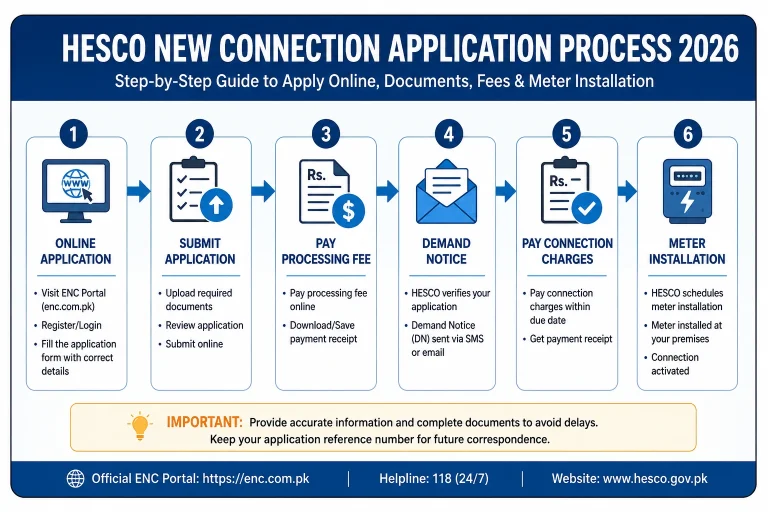
HESCO New Connection Application Process
HESCO New Connection Application Process 2026 HESCO New Connection Application Process 2026: Complete Online Guide Last updated: 20 June 2026 · By Amir Hanif The HESCO new connection application process starts online at the ENC portal (enc.com.pk). Click “Apply”, select HESCO and your subdivision, fill the form, and upload your CNIC, property ownership proof, witness…
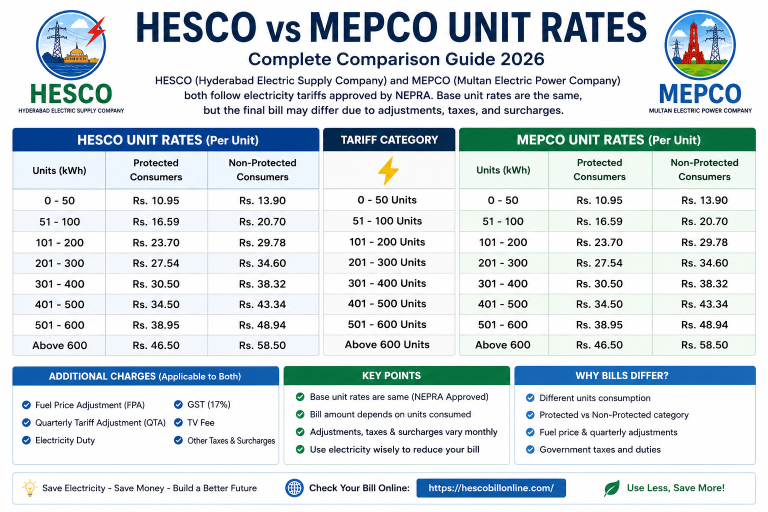
Hesco vs mepco unit rates
HESCO vs MEPCO Unit Rates: Which Electricity Company Charges More? If you’re comparing HESCO vs MEPCO unit rates, the short answer is that both distribution companies follow electricity tariffs approved by NEPRA and notified by the Government of Pakistan. In most cases, the base per-unit tariff is the same, but your final electricity bill can…
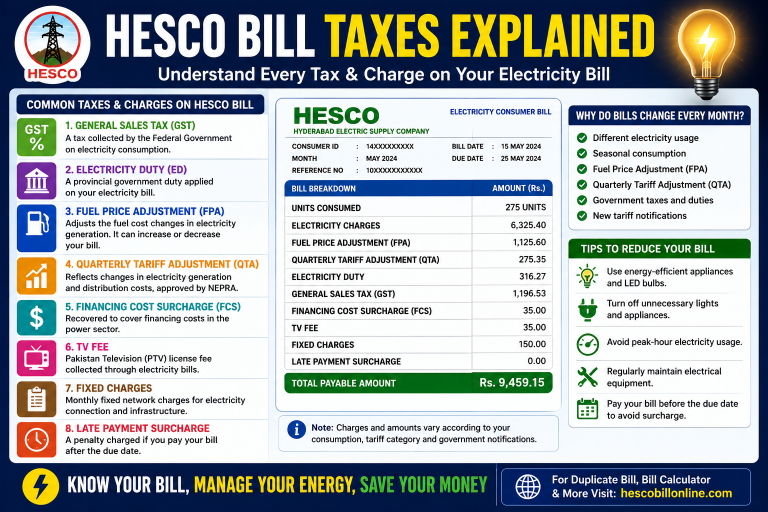
HESCO Bill Taxes Explained
HESCO Bill Taxes Explained – Complete Guide to Every Tax on Your Electricity Bill If you’ve ever wondered why your HESCO electricity bill is higher than expected, the answer often lies in the taxes and additional charges included in the bill. Besides electricity units, your monthly HESCO bill contains government taxes, surcharges, duties, and service…
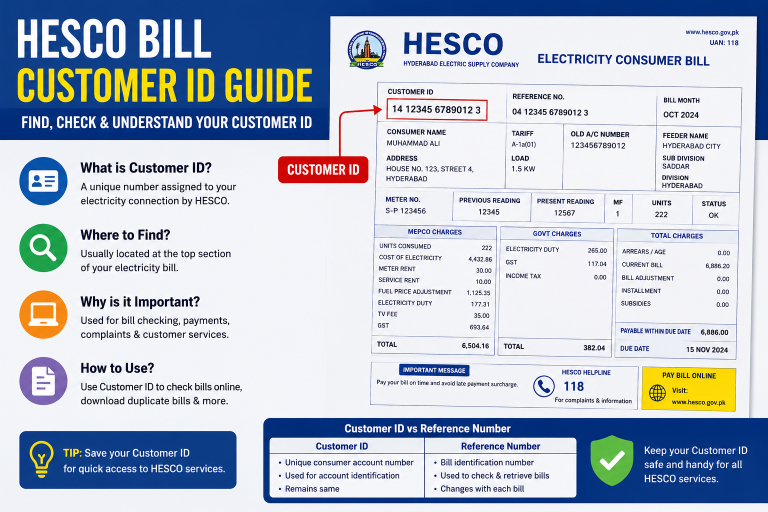
Hesco Bill customer id guide
HESCO Bill Customer ID Guide If you want to check your HESCO electricity bill online, download a duplicate bill, register a complaint, or use digital payment services, you must know your HESCO Bill Customer ID. This unique number identifies your electricity connection and helps HESCO process billing, payments, and customer services accurately. In this complete…
HESCO Net Metering Guide
HESCO Net Metering Guide: Complete Installation & Billing Process HESCO Net Metering Guide: Everything You Need to Know About Solar Installation and Billing Updated: June 2026 | Read Time: 8-10 minutes | Region: Hyderabad Electric Supply Company (HESCO) What is HESCO Net Metering? Net metering is a billing arrangement that allows residential and commercial customers…