HESCO Net Metering Guide: Everything You Need to Know About Solar Installation and Billing
What is HESCO Net Metering?
Net metering is a billing arrangement that allows residential and commercial customers to generate their own electricity through solar panels and sell excess power back to HESCO (Hyderabad Electric Supply Company). In simple terms, when your solar system produces more energy than you’re using, that surplus power gets fed into the grid, and HESCO credits your account. You pay only for the net electricity you consume, not the gross amount supplied.
For Hyderabad customers, this system has become increasingly popular as energy costs rise and solar panel prices drop. Net metering can reduce your electricity bill by 50% to 90% depending on your solar installation size and daily consumption patterns.
How Does HESCO Net Metering Actually Work?
The Basic Mechanism
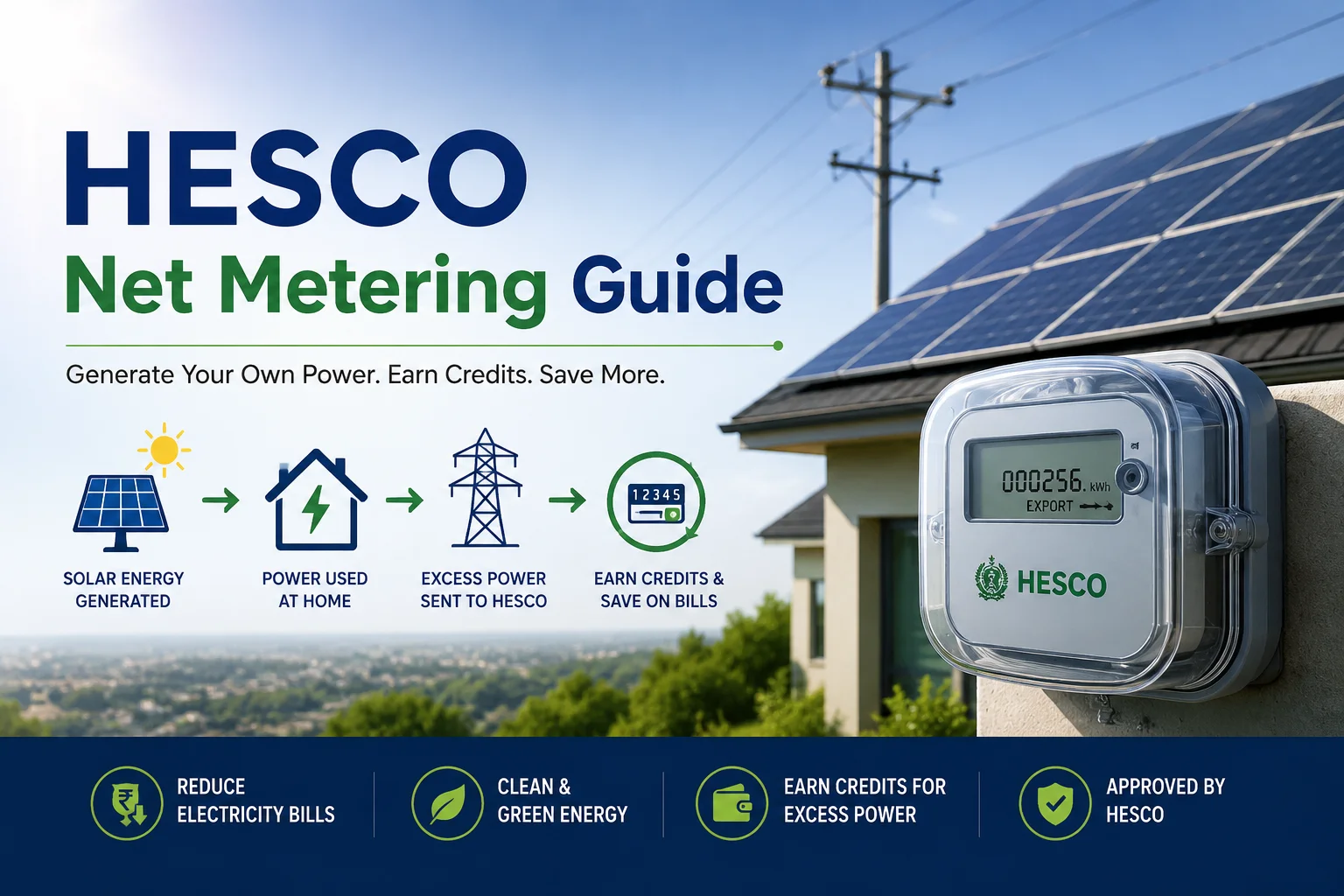
Your solar panels generate DC electricity during sunlight hours. An inverter converts this into AC electricity that matches the grid frequency. A bidirectional meter tracks electricity flow in both directions: power flowing into your home and excess power flowing back to HESCO’s grid.
Here’s the flow:
- Solar panels generate electricity during the day
- Your home uses this electricity first
- Excess power flows to the grid (meter spins backward)
- At night or cloudy days, you use grid power (meter spins forward)
- Your monthly bill shows only the net difference
The Role of the Bidirectional Meter
The standard HESCO net metering meter is bidirectional, meaning it measures electricity in both directions. When solar power flows backward to the grid, the meter credits your account. HESCO treats this as a credit that offsets your consumption during evening and night hours when solar isn’t generating.
Key Benefits of HESCO Net Metering
| Benefit | Impact on Your Bill | Implementation Timeline |
|---|---|---|
| Reduced electricity costs | 50-90% savings on monthly bills | Immediate after installation |
| Protection against rate increases | Locks in current rates for solar-generated power | Long-term benefit (25-30 years) |
| Increased property value | 3-4% increase in home resale value | Realized at property sale |
| Environmental impact | Reduces carbon footprint by 3-4 tons annually | Immediate |
| Battery backup compatibility | System can store excess energy | Optional, can be added later |
| No transmission fees on solar power | Save on distribution charges | Immediate after approval |
Step-by-Step HESCO Net Metering Installation Process
Step 1: Check Your Eligibility
Before installing a solar system with HESCO net metering, verify these requirements:
- You must be a HESCO customer in good standing with no outstanding bills
- Your property must have sufficient roof space or ground area for panels
- Your electrical connection must be active and have adequate capacity
- You must not be connected to a solar net metering agreement already
- Your property taxes and utility payments must be current
Step 2: Get Your Connection Capacity Assessment
Contact HESCO’s net metering department to understand your connection’s maximum allowable solar capacity. Residential connections typically allow systems ranging from 2 kW to 10 kW, while commercial connections may allow larger installations. This assessment is free and helps determine your solar system’s ideal size.
Step 3: Select a Qualified Installer
Choose a HESCO-approved solar installer. These companies understand local regulations, safety codes, and specific HESCO requirements. Ask for references from previous net metering installations and verify their experience with bidirectional meter installations.
Step 4: Submit Application to HESCO
Your installer or you can submit the net metering application to HESCO with these documents:
- Completed net metering application form
- Copy of your electricity bill
- System design and technical specifications
- Electrical installation plan
- Property ownership proof or NOC from landlord
- CNIC copy and photographs
Step 5: Wait for HESCO Approval
HESCO typically approves applications within 5-7 working days. They’ll verify your eligibility, check system design compliance, and confirm grid capacity availability. You’ll receive a formal approval letter detailing your system’s approved capacity and terms.
Step 6: Installation and Meter Replacement
After approval, your installer sets up the solar panels, inverter, and safety equipment. Crucially, HESCO will replace your existing meter with a bidirectional net metering meter. This meter is installed by HESCO’s authorized technicians at no charge.
Step 7: Final Inspection and Activation
HESCO sends an inspector to verify the installation meets safety and technical standards. Once approved, they activate your net metering agreement. Your system becomes active, and billing begins immediately on a net metering basis.
HESCO Net Metering Billing Explained
How Your Bill Changes
Under net metering, you’re billed for your net consumption. If you generate 500 units in a month and consume 700 units, you pay for only 200 units. The 500 units you generated reduce your bill directly.
However, you still pay:
- Fixed monthly charges (regardless of generation)
- Minimum bills (some tariffs have minimums)
- Taxes and levies on net consumption
- Transmission and distribution charges on grid usage
Understanding Your HESCO Net Metering Bill
Your bill will show two columns: consumption from grid and generation fed back to grid. The net difference is what you actually pay. Many customers see their bills drop from 3,000-5,000 PKR monthly to 500-1,500 PKR after net metering installation.
During summer when solar generation peaks, many customers’ bills become almost zero or show credits that roll over to winter months.
Costs and Savings Analysis
Initial Investment Breakdown
A typical 5 kW residential solar system costs 450,000-600,000 PKR installed. This includes:
- Solar panels: 200,000-280,000 PKR (50-60% of total)
- Inverter: 120,000-180,000 PKR (25-30%)
- Wiring, mounting, safety equipment: 80,000-120,000 PKR (15-20%)
- HESCO net metering application and inspection fees: 5,000-10,000 PKR
Return on Investment Timeline
Based on average HESCO electricity rates and usage patterns, most residential customers achieve payback in 4-6 years. After that period, your solar electricity is essentially free. Since solar panels last 25-30 years, you’ll benefit from 19-26 years of free electricity generation.
This means lifetime savings ranging from 800,000 to 1,200,000 PKR for a typical household.
Common HESCO Net Metering Issues and Solutions
Issue: Meter Reading Discrepancies
Problem: Your solar generation doesn’t match the meter reading.
Solution: Request HESCO to recalibrate the bidirectional meter. This usually happens due to meter positioning or loose connections. Contact HESCO’s net metering team for a free checkup.
Issue: System Not Generating Expected Power
Problem: Your system generates less power than calculated.
Solution: Check for panel shading, dust accumulation, or inverter issues. Most problems are resolved by cleaning panels or adjusting their angle. Contact your installer for professional diagnostics.
Issue: Approval Delays
Problem: HESCO is taking longer than expected to approve your application.
Solution: Follow up with HESCO’s net metering department directly. Incomplete applications are the main cause of delays. Ensure all documents are correctly submitted.
HESCO Net Metering vs. Off-Grid Systems: Which is Right for You?
| Feature | Net Metering | Off-Grid with Battery |
|---|---|---|
| Upfront cost | Lower (no batteries) | Higher (expensive batteries) |
| Electricity availability | 24/7 (grid + solar) | Depends on battery capacity |
| Reliability | Highly reliable | Limited by battery condition |
| Maintenance | Minimal | Regular battery checks needed |
| Bill reduction | 50-90% | Can reach 100% |
| Best for | Most urban customers | Remote areas, load shedding regions |
Important Regulations and Compliance
HESCO’s net metering follows NEPRA (National Electric Power Regulatory Authority) standards. Key regulations you should know:
- System capacity cannot exceed 120% of your connection’s contracted load
- You must use certified inverters that comply with IEEE standards
- An isolation switch must disconnect your system from the grid during outages
- Anti-islanding protection is mandatory to prevent grid damage
- Only HESCO-approved electricians can make final connections
Violating these regulations can result in disconnection from the net metering scheme and penalties.
Key Takeaways
- Net metering credits solar generation against grid consumption, reducing bills by 50-90%
- A bidirectional meter automatically tracks both power you use and power you generate
- Installation takes 5-7 days for HESCO approval, then 2-3 days for physical setup
- A 5 kW system costs 450,000-600,000 PKR and pays for itself in 4-6 years
- You still pay fixed charges and taxes, but savings are substantial over the system’s 25-30 year lifespan
- Always choose HESCO-approved installers to ensure compliance and reliability
Frequently Asked Questions About HESCO Net Metering
No, you cannot exceed your approved capacity. However, you can apply for a new agreement if HESCO’s grid can accommodate it. In most cases, you get one approval for one system size.
Most utilities roll over credits for 12 months. Any unused credits after 12 months are typically forfeited. Check your specific HESCO agreement for details.
No, batteries are optional. Net metering uses the grid as your backup. If you want 24/7 power during load shedding without grid dependency, then add batteries.
Yes, but you need written permission (NOC) from your landlord. Some property owners hesitate because the system is considered a permanent fixture. Discuss ownership terms clearly before installation.
In Hyderabad’s climate, clean panels every 3-4 weeks during dry season. During monsoon, natural rain cleans them. Dusty panels lose 15-25% efficiency, so regular cleaning is important.
HESCO doesn’t handle system repairs. That’s your installer’s responsibility under warranty. However, HESCO can help with meter issues. Always buy systems from installers with strong warranty terms and service centers.
No, net metering credits are non-transferable. They benefit only your account. You cannot sell electricity directly to others as it violates utility regulations.
Solar systems don’t typically increase property taxes in Hyderabad, but confirm with your local tax office. The investment in solar increases property value but doesn’t automatically increase tax assessments.
Practical Tips for Maximizing Your HESCO Net Metering Savings
Tip 1: Right-Size Your System
Calculate your average monthly consumption from previous HESCO bills. A good rule: your solar system should generate 80-100% of your annual consumption. Oversizing might seem tempting, but you can only get credits up to your actual consumption.
Tip 2: Shift Your Usage to Peak Solar Hours
Run high-load appliances like washing machines, water pumps, and air conditioners during peak solar generation hours (9 AM to 4 PM). This increases self-consumption and maximizes savings.
Tip 3: Maintain Your System Regularly
Annual maintenance costing 5,000-10,000 PKR keeps your system running at peak efficiency. This includes professional cleaning, electrical checks, and inverter servicing.
Tip 4: Monitor Your Generation
Most modern inverters have apps showing real-time generation. Monitor these to spot issues early. A sudden drop in generation often indicates shading, panel damage, or inverter malfunction.
The Environmental Impact of HESCO Net Metering
Switching to net metering isn’t just about saving money. A single 5 kW residential system prevents approximately 4 tons of CO2 emissions annually. Across Hyderabad’s growing solar adoption, this means avoiding hundreds of thousands of tons of greenhouse gases yearly.
By choosing net metering, you’re contributing to cleaner air, reduced dependence on fossil fuels, and a more sustainable energy future for Pakistan. This environmental benefit is becoming increasingly important as climate change impacts worsen.
What’s Next? Future of HESCO Net Metering
The solar industry in Pakistan is evolving rapidly. Future changes to HESCO net metering might include:
- Smart grid integration for better tracking and optimization
- Time-of-use rates that credit off-peak generation differently
- Integration with electric vehicle charging systems
- AI-based energy management systems predicting consumption patterns
Stay informed about HESCO announcements to adapt your system for future changes.
Ready to Start Your HESCO Net Metering Journey?
Take control of your electricity costs today. Evaluate your eligibility, choose a certified installer, and join thousands of Hyderabad customers already benefiting from net metering.
Visit hescobillsonline.com for official guidelines or contact HESCO’s net metering department for personalized assistance.
Apply for Net Metering Today