HESCO Unit Rates Explained 2026: Per-Unit Price & Slabs
Last updated: 22 June 2026 · By Amir Hanif
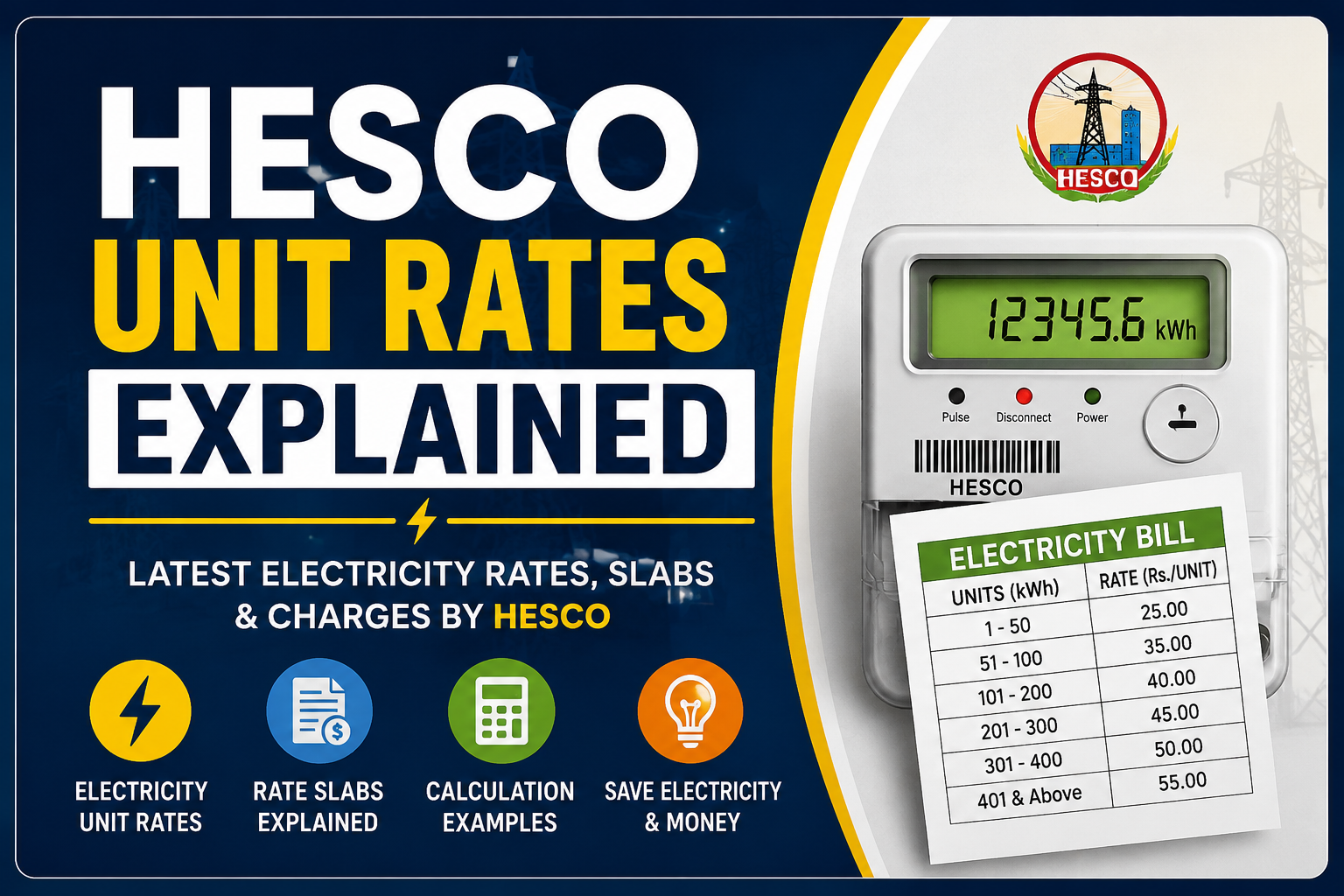
HESCO unit rates are the per-unit (per kWh) prices you pay for electricity, set by NEPRA using a slab system. For 2026, rates range from about Rs.3.95 per unit for lifeline users up to around Rs.47.69 per unit for high-usage domestic consumers. Your final bill adds GST, Fuel Price Adjustment (FPA), a government surcharge, and fixed charges on top of the basic slab rate, which is why the total is always more than just units × rate.
Ever looked at your electricity bill and wondered why the amount doesn’t simply match your usage times a single rate? You’re not alone. HESCO’s billing uses a layered, slab-based system where different blocks of units cost different amounts, and several extra charges stack on top. Once you understand how it works, your bill stops being a mystery.
This guide explains HESCO unit rates in plain English — the 2026 slab structure, the all-important protected vs unprotected categories, every extra charge, and practical tips to keep your bill low. All figures are based on NEPRA’s approved tariff for the 2025–26 period.
What Are HESCO Unit Rates?
A “unit” of electricity is one kilowatt-hour (kWh) — the amount of energy used by a 1,000-watt appliance running for one hour. Your HESCO unit rate is the price charged for each unit you consume.
The key thing to understand is that HESCO does not charge a single flat rate. Instead, it uses a progressive slab system approved by the National Electric Power Regulatory Authority (NEPRA). Each block (slab) of units is charged at its own rate, and the rate generally rises as you use more.
These same NEPRA-approved rates apply across all government distribution companies — LESCO, IESCO, MEPCO, FESCO, GEPCO, PESCO, SEPCO, and QESCO — so HESCO’s structure mirrors the national framework.
Protected vs Unprotected Consumers: The Most Important Difference
Before looking at the rates, you must understand your consumer category, because it dramatically changes what you pay. NEPRA splits domestic users into three groups.
Lifeline Consumers
The lowest-usage households, using up to 100 units per month. They get the most heavily subsidized rates and are exempt from most taxes.
Protected Consumers
Households whose consumption stays at or below 200 units in every one of the last six months. They pay lower, subsidized per-unit rates and no GST.
Unprotected (Non-Protected) Consumers
Anyone who exceeds 200 units in any month becomes unprotected for the next six months. They pay higher rates plus 18% GST across all their units.
⚠️ The Slab Jump Trap
This is the most misunderstood part of the system. If you cross 200 units even once, you lose protected status for the next six months — and the higher rates apply to your entire consumption, not just the units above 200. A 190-unit bill might be around Rs.3,100, but a 210-unit bill can jump to roughly Rs.8,600. Always try to stay under the threshold.
HESCO Unit Rates 2026: Slab-Wise Table
Here is the approximate domestic slab structure for 2026, based on NEPRA’s approved tariff. Rates are per unit and shown by consumer category.
| Consumer Type | Units / Slab | Rate (Rs./unit) |
|---|---|---|
| Lifeline | 1–100 | Rs.3.95 |
| Lifeline | 101–200 | Rs.7.74 |
| Protected | 1–100 | Rs.7.74 |
| Protected | 101–200 | Rs.10.06 |
| Unprotected | 1–100 | Rs.23.59 |
| Unprotected | 101–200 | Rs.30.07 |
| Unprotected | 201–300 | Rs.34.26 |
| Unprotected | 301–400 | Rs.39.15 |
| Unprotected | 401–500 | Rs.41.36 |
| Unprotected | 501–600 | Rs.42.82 |
| Unprotected | 601–700 | Rs.45.20 |
| Unprotected | Above 700 | Rs.47.69 |
These figures are indicative and set by NEPRA; the exact rates on your bill may differ slightly and are revised periodically. Always confirm with your current bill, which you can check online here.
How a HESCO Bill Is Actually Calculated
Your total bill is built from several layers, not just the energy charge. Here’s the full picture:
- Energy charge — units in each slab × that slab’s rate, added together.
- Fixed charges / meter rent — a small monthly cost regardless of usage.
- Fuel Price Adjustment (FPA) — a monthly variable charge, roughly Rs.3.0–4.5 per unit.
- Government surcharge — an extra levy (around Rs.3.82 per unit in early-to-mid 2026).
- GST (18%) — sales tax, applied to unprotected consumers.
- Electricity Duty — a provincial tax.
- TV license fee — a fixed monthly charge.
- Arrears — any unpaid amount carried forward.
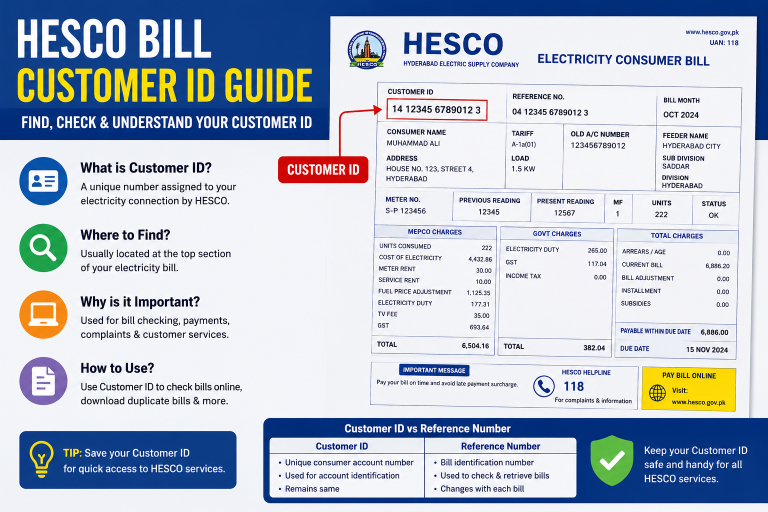
The basic formula is simple: Total Bill = Energy Charge + Taxes + Surcharges + FPA + Fixed Charges. To understand each line on your actual bill, see our guide on the HESCO reference number and how to read your bill details.
A Real Example: How the Slabs Add Up
Let’s calculate the energy charge for an unprotected consumer using 350 units (rates approximate):
| Slab | Units | Rate | Cost |
|---|---|---|---|
| 1–100 | 100 | Rs.23.59 | Rs.2,359 |
| 101–200 | 100 | Rs.30.07 | Rs.3,007 |
| 201–300 | 100 | Rs.34.26 | Rs.3,426 |
| 301–350 | 50 | Rs.39.15 | Rs.1,958 |
| Energy charge subtotal | Rs.10,750 | ||
On top of this Rs.10,750 energy charge, you’d add 18% GST, FPA, the surcharge, fixed charges, and the TV fee — pushing the final bill higher. This is exactly why two homes using “about the same” electricity can get very different bills depending on their category and slab.
💡 Expert Tip from the Field
The single most valuable habit I recommend is checking your meter around the 25th of each month. If you’re already near 180–190 units, easing off for the last few days can keep you under the 200-unit protected threshold — and that one decision can save you thousands of rupees, because losing protected status re-prices every single unit at the much higher unprotected rate. Most people never realize how close they were to staying protected.
What Is FPA and Why Does It Change Every Month?
The Fuel Price Adjustment (FPA) is one of the biggest reasons your bill changes even when your usage doesn’t. It reflects the actual cost of fuel — gas, coal, oil — used to generate electricity in a given month.
Key points about FPA on a HESCO bill:
- NEPRA announces it monthly, so it varies from bill to bill.
- For HESCO it typically ranges between about Rs.3.0 and Rs.4.5 per unit.
- It can be positive (added) or, rarely, negative (a credit).
- It’s charged on top of your slab rate, raising your effective per-unit cost.
Because fuel costs rise when the rupee weakens or global prices climb, FPA is a major driver of bill increases in Pakistan.
Commercial and Industrial Unit Rates
The slabs above apply to domestic (residential) users under tariff A-1. Other categories work differently:
- Commercial (A-2) — shops and offices pay higher rates, often a flatter structure (e.g. around Rs.32+ per unit) without the same slab subsidies.
- Industrial — factories have their own tariff with time-of-use pricing (peak vs off-peak).
- Agricultural — tube wells and farming have separate, often subsidized rates.
If you’re applying for a new connection in any category, our guides on the HESCO new connection application process and HESCO new meter charges explain the setup costs.
How to Lower Your HESCO Unit Costs
You can’t change the tariff, but you can control which slabs you land in. These proven steps help:
- Stay under 200 units to keep protected status and avoid GST.
- Monitor your meter every few days so you never accidentally cross a slab.
- Switch to LED bulbs — they use up to 80% less energy than old bulbs.
- Set your AC to 26°C — every degree lower adds roughly 8% to cooling costs.
- Unplug idle appliances — many draw power even when off.
- Avoid peak hours (6 PM–10 PM) for heavy appliances where possible.
- Service your appliances — a clean AC filter and fridge coils use less power.
🔑 Key Takeaways
- HESCO uses NEPRA slab rates, not a single flat per-unit price.
- 2026 rates run from about Rs.3.95 (lifeline) to Rs.47.69 (700+ units).
- Protected (≤200 units) pay low rates and no GST; unprotected pay more plus 18% GST.
- Crossing 200 units re-prices all your units — the slab-jump trap.
- Your bill adds FPA, surcharge, GST, fixed charges, and TV fee on top of slabs.
- FPA (Rs.3–4.5/unit) changes monthly with fuel costs.
- Staying under 200 units is the biggest money-saver.
Frequently Asked Questions
What are HESCO unit rates?
What is the difference between protected and unprotected HESCO consumers?
How much is one unit of HESCO electricity in 2026?
Why is my HESCO bill higher than units multiplied by the rate?
What is FPA on a HESCO bill?
How can I lower my HESCO unit costs?
Check Your HESCO Bill & Rates
See exactly which slabs and charges apply to you. Enter your reference number to view your latest bill, units, and per-unit breakdown — free and instant.
Check Your HESCO Bill →Disclaimer: Unit rates and charges are based on NEPRA’s approved 2025–26 tariff and are indicative; they change with monthly FPA, surcharges, and NEPRA revisions. HESCO Bill Online is independent and not affiliated with HESCO, WAPDA, or NEPRA. Confirm current rates on the official HESCO tariff page and NEPRA.