HESCO vs K-Electric Unit Price Comparison
Complete breakdown of electricity tariffs, rates, and charges for 2026
📋 Quick Navigation
Understanding HESCO vs K-Electric: Key Differences
Pakistan’s electricity sector is managed through ten main distribution companies (DISCOs), each serving specific geographical regions. HESCO (Hyderabad Electric Supply Company) and K-Electric are two major providers operating in Pakistan, but they serve different markets with distinct tariff structures. Understanding the differences between these two utilities is crucial for consumers who want to manage their electricity costs effectively.
Geographic Coverage and Operation
HESCO operates exclusively across Sindh province, primarily serving Hyderabad, Sukkur, Mirpurkhas, Nawabshah, and Larkana districts. As a state-owned utility regulated by NEPRA (National Electric Power Regulatory Authority), HESCO serves over 3 million consumers across residential, commercial, and industrial categories.
K-Electric, by contrast, is Pakistan’s only privatized electricity distribution company, operating exclusively in Karachi and its surrounding areas. Despite serving a single metropolitan region, K-Electric manages approximately 2.6 million consumer connections with a mix of residential, commercial, and industrial clients.
Regulatory Framework
Both utilities operate under NEPRA’s regulatory framework, but their ownership and management models differ significantly. HESCO, as a state-owned enterprise, follows uniform tariff policies aligned with other government DISCOs. K-Electric’s private ownership structure allows for more flexible operational models, though it remains bound by NEPRA’s tariff determinations and regulations.
HESCO Unit Prices and Tariff Slabs 2026
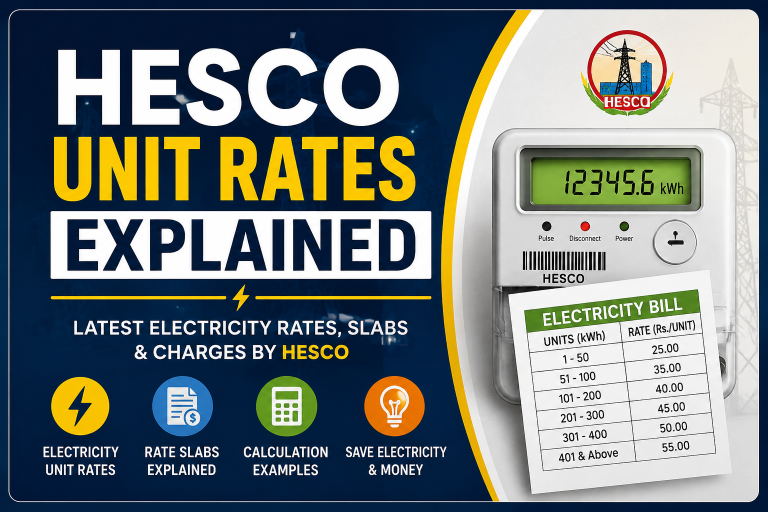
HESCO implements a slab-based tariff system where electricity consumption is divided into categories, and each slab carries a different unit price. This progressive pricing structure encourages conservation while keeping essential usage affordable for low-income consumers.
Residential Tariff Slabs
HESCO’s residential tariff for domestic consumers typically includes the following slab structure (rates subject to NEPRA adjustments and FCA):
| Consumption Range | Unit Price (approx.) | Category | Subsidy Status |
|---|---|---|---|
| 0-50 units/month | Rs 14-16/kWh | Lifeline Tariff | Full Subsidy |
| 51-100 units/month | Rs 17-19/kWh | Basic Domestic | Subsidized |
| 101-200 units/month | Rs 20-23/kWh | Protected Consumers | Subsidized |
| 201-300 units/month | Rs 25-28/kWh | Unprotected Consumers | No Subsidy |
| Above 300 units/month | Rs 30-32/kWh | High Consumer | Full Cost |
Additional HESCO Bill Components
Your HESCO bill includes several charges beyond the base unit price:
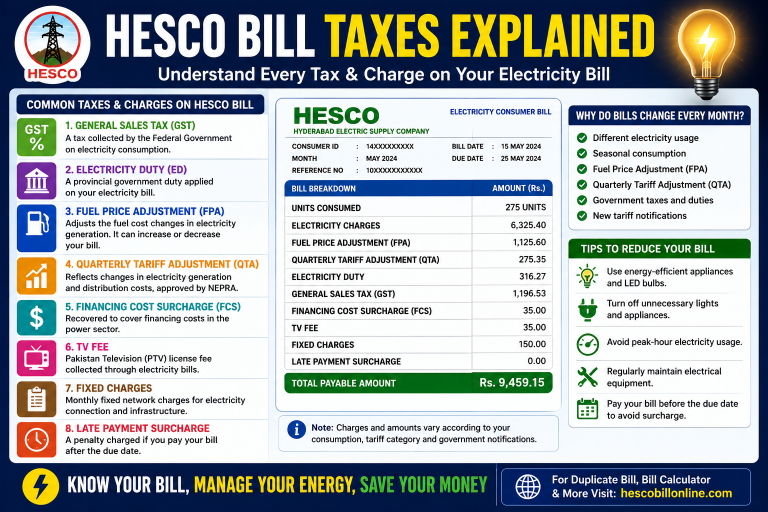
- Fuel Cost Adjustment (FCA): Monthly adjustment (Rs 2-8 per unit) reflecting fuel market prices
- Quarterly Tariff Adjustment (QTA): Applied every 3 months based on operational costs
- Fixed Charges: Rs 50-150 monthly meter rent depending on load
- GST (General Sales Tax): 17% on energy and other charges
- Meter Rent: Rs 75 for single-phase, Rs 500+ for 3-phase connections
Commercial and Industrial Rates
HESCO offers separate tariff structures for commercial and industrial consumers, typically ranging from Rs 22-40 per unit depending on load size, with additional demand charges based on sanctioned load capacity.
K-Electric Unit Prices and Tariff Slabs 2026
K-Electric operates under a two-tier consumer classification system: Protected Consumers (0-200 units monthly, subsidized) and Unprotected Consumers (above 200 units, full cost-recovery tariffs). This structure reflects K-Electric’s complex subsidy and cost-recovery model approved by NEPRA.
Residential Tariff Slabs (Protected Consumers: 0-200 units)
Protected consumers in Karachi benefit from government subsidies that keep rates lower:
| Consumption Range | Unit Price | Monthly Savings vs Unprotected |
|---|---|---|
| 0-50 units | Rs 16.48/kWh | Rs 250-350/month |
| 51-100 units | Rs 20.85/kWh | Rs 400-500/month |
| 101-200 units | Rs 22.94/kWh | Rs 600-800/month |
Residential Tariff Slabs (Unprotected Consumers: Above 200 units)
Unprotected consumers pay higher rates without government subsidies:
| Consumption Range | Unit Price | Applied To |
|---|---|---|
| 201-300 units | Rs 27.45/kWh | Units beyond 200 |
| 301-500 units | Rs 31.22/kWh | Units beyond 300 |
| 501-700 units | Rs 33.18/kWh | Units beyond 500 |
| Above 700 units | Rs 35.24/kWh | All units above 700 |
K-Electric Bill Components
Similar to HESCO, K-Electric bills include multiple charges:
- Fuel Cost Adjustment (FCA): Variable monthly charge (Rs 3-6 per unit typically)
- Quarterly Tariff Adjustment (QTA): Operational cost adjustments every three months
- Meter Rent: Rs 75-150 for single-phase, Rs 500-800 for 3-phase
- GST: 17% applicable on relevant charges
- TV Fee: Rs 35/month (if applicable)
- Service Tax: Applied based on consumer category and location
Direct HESCO vs K-Electric Price Comparison
HESCO Example Bill
Consumption: 150 units/month
Includes base rate, FCA, QTA, GST, and meter rent
K-Electric Example Bill
Consumption: 150 units/month
Protected consumer with all charges included
Which DISCO is Cheaper?
For low consumption (0-200 units): K-Electric protected consumers typically enjoy lower rates due to subsidy benefits. HESCO’s subsidized consumers also get reasonable rates, but K-Electric’s protection mechanism keeps costs slightly lower in urban Karachi.
For medium consumption (200-300 units): Both utilities charge similar rates, with differences emerging based on fuel cost adjustments and quarterly variations. K-Electric’s transition to unprotected status creates a price jump at 200 units.
For high consumption (above 300 units): HESCO and K-Electric rates converge around Rs 30-35 per unit when all adjustments are included. The difference becomes minimal, with FCA and seasonal variations playing larger roles.
| Factor | HESCO | K-Electric |
|---|---|---|
| Service Area | Sindh (Hyderabad, Sukkur, etc.) | Karachi & Suburbs |
| Ownership | State-owned (Government) | Private (Saudi + Kuwait) |
| 0-50 Units Rate | Rs 14-16/kWh | Rs 16.48/kWh |
| 100-200 Units Rate | Rs 20-23/kWh | Rs 22.94/kWh |
| 300+ Units Rate | Rs 30-32/kWh | Rs 33-35/kWh |
| Typical Monthly Bill (150u) | Rs 3,200-3,500 | Rs 3,100-3,400 |
| Meter Rent | Rs 75/month | Rs 75-150/month |
| Payment Methods | Banks, JazzCash, EasyPaisa | Banks, Mobile Wallets, Online |
Key Factors Affecting Your Electricity Bill
1. Fuel Cost Adjustment (FCA)
The most volatile component of your bill is the Fuel Cost Adjustment. Both HESCO and K-Electric apply FCA monthly based on global fuel prices. When crude oil prices rise, FCA adds Rs 3-8 per unit; when prices fall, it provides relief. A 50-unit consumer can see monthly bill variations of Rs 150-400 due to FCA alone.
2. Quarterly Tariff Adjustment (QTA)
Applied every three months, QTA reflects changes in operational costs, maintenance expenses, and NEPRA’s periodic tariff reviews. QTA can add or subtract Rs 0.5-2 per unit depending on the utility’s cost structure.
3. Seasonal Variations
Summer months (May-August) typically see increased consumption due to air conditioning, resulting in higher bills. Winter months show lower usage and reduced costs. Your consumption pattern directly impacts which slab you fall into and what rates apply.
4. Connection Type and Load Size
Single-phase connections (standard residential) have fixed meter rent around Rs 75/month. Three-phase connections (used by small businesses) charge Rs 500-800/month. Your sanctioned load (1kW, 2kW, 3kW, etc.) also affects monthly fixed charges.
5. Area-Based Variations
Even within HESCO’s service area, urban consumers may face different rates than rural areas. K-Electric’s pricing also varies slightly based on Karachi’s specific zones and commercial areas. Always check your bill for area-specific surcharges.
6. Government Subsidies and Protections
If you’re classified as a protected consumer by HESCO (below 200 units) or K-Electric (0-200 units), you benefit from government subsidies that can reduce your per-unit cost by 20-30%. Once you exceed the threshold, you lose protection and pay full cost-recovery rates.
How to Reduce Your Electricity Bill
Smart Usage Tips
- Stay Below 200 Units: Maintaining consumption under the 200-unit threshold keeps you in the subsidized consumer category, saving Rs 2,000-3,000 monthly
- AC Management: Running AC at 26°C instead of 22°C reduces consumption by 15-20% (saves Rs 500-1,000 in summer)
- LED Lighting: Switching to LEDs cuts lighting costs by 75%, saving Rs 300-500 monthly
- Unplug Standby Devices: Eliminate phantom load from TVs, chargers, and computer equipment (saves Rs 100-150/month)
- Water Heating Off-Peak: Heat water during off-peak hours if you have time-of-use metering (saves Rs 200-400/month)
- Refrigerator Efficiency: Clean coils monthly and maintain proper temperature settings (saves Rs 100-200/month)
Long-Term Investments
Solar Energy System: Installing a 3-5kW solar panel system costs Rs 300,000-600,000 but provides 100% electricity independence. You save the entire bill amount (Rs 3,500+ monthly) and achieve ROI in 3-5 years. K-Electric and HESCO both support net metering, allowing you to feed excess solar power back to the grid.
Energy-Efficient Appliances: Inverter ACs, refrigerators, and water heaters use 30-40% less energy. Initial cost premium is recovered within 2-3 years through bill savings.
Monitoring and Maintenance
- Check your bill monthly for unusual spikes
- Maintain your meter and appliances in good condition
- Request a bill audit if consumption seems excessive
- Use smart plugs to monitor real-time electricity usage
⚡ Potential Monthly Savings Breakdown
- AC Optimization: Rs 300-600/month
- LED Conversion: Rs 250-400/month
- Eliminating Phantom Load: Rs 100-150/month
- Peak Hour Shifting: Rs 200-300/month
- Equipment Maintenance: Rs 150-250/month
- Total Potential Savings: Rs 1,000-1,700/month (30-35% reduction)
Frequently Asked Questions
HESCO serves Sindh province with rates ranging from Rs 14-32/kWh depending on consumption slabs and subsidies. K-Electric operates in Karachi with rates from Rs 16.48-35.24/kWh, using a protected (0-200 units) vs. unprotected (200+ units) consumer classification. For low consumption (below 200 units), both utilities offer similar rates, with HESCO sometimes slightly cheaper. For high consumption, K-Electric rates can be 10-15% higher due to its cost-recovery model for unprotected consumers.
FCA is a monthly charge that reflects changes in fuel prices used for electricity generation. When global oil and gas prices increase, FCA adds Rs 3-8 per unit to your bill. When prices decline, it provides relief (negative FCA). FCA is calculated by the utilities based on NEPRA’s approved fuel cost components and applied uniformly to all consumer categories. You’ll see the exact FCA amount on your monthly bill under “Fuel Cost Adjustment.”
Yes, absolutely. If you currently consume 250 units and reduce to 200 units monthly (through energy conservation), you can transition from unprotected to protected status with K-Electric, reducing your per-unit rate significantly. Similarly with HESCO, staying below their subsidy thresholds ensures you benefit from lower rates. Every unit you conserve directly reduces your bill while moving you toward cheaper tariff slabs.
Your choice isn’t optional—your electricity provider is determined by your location. If you’re in Karachi, you must use K-Electric. If you’re in Hyderabad, Sukkur, or Sindh’s other cities, you’re served by HESCO. You cannot choose between them based on tariffs. However, you can choose where to live based on utility efficiency, service quality, and unit prices if you’re relocating.
Meter rent (typically Rs 75-150 for residential connections) covers the cost of meter maintenance, periodic meter testing, meter calibration, and infrastructure upkeep by the utility company. It’s a fixed monthly charge separate from your energy consumption charges. This ensures accurate billing and maintains the metering infrastructure serving your area.
Base tariff rates change annually or as determined by NEPRA (typically in July for fiscal year changes). However, Fuel Cost Adjustments (FCA) change monthly, and Quarterly Tariff Adjustments (QTA) change every three months. This means your per-unit cost can vary 5-15% month-to-month due to FCA fluctuations alone, even if base tariffs remain unchanged.
Yes, both utilities support net metering for solar customers. You can install solar panels and export excess power back to the grid, earning credits that offset your future bills. With current tariffs (Rs 20-35/kWh), a 5kW solar system can save you Rs 4,500-8,000 monthly and pay for itself in 3-5 years. The government also offers financing at subsidized rates for solar installations.
First, compare it with your previous three months’ bills—you might have crossed into a higher slab due to increased consumption. Check if FCA or QTA adjustments spiked that month. Verify your meter reading is correct (compare with your previous bill’s ending reading). Request a bill audit from your utility if there’s a suspicious jump. For HESCO, contact 24/7 helpline or nearest office; for K-Electric, use their call center 118 or visit customer care centers in Karachi.
🔑 Key Takeaways
- HESCO unit prices range Rs 14-32/kWh; K-Electric charges Rs 16.48-35.24/kWh, depending on consumption and consumer type
- For low consumption (0-200 units), both utilities offer subsidized rates; K-Electric’s protected consumer status is particularly beneficial
- FCA (Fuel Cost Adjustment) varies monthly with global fuel prices—expect Rs 3-8/unit fluctuations throughout the year
- Meter rent, GST, and QTA add 20-30% to your final bill amount; don’t calculate costs based on unit rates alone
- Staying below 200 units monthly significantly reduces your per-unit cost and total bill amount
- Solar energy can cut your electricity bills by 80-100% and provides independence from utility tariff changes
- HESCO serves Sindh (Hyderabad, Sukkur); K-Electric serves Karachi exclusively
- Both utilities apply identical regulatory framework, but tariff structures differ based on geography and private vs. state ownership
Conclusion: Making Informed Electricity Choices
Understanding the difference between HESCO and K-Electric unit prices empowers you to make informed decisions about energy consumption and long-term investments. While geographic location determines which utility you use, knowledge of tariff structures, slab categories, and cost components helps you optimize your monthly bills.
For HESCO customers in Sindh, keeping consumption under 200 units maintains subsidized rates around Rs 14-23/kWh. For K-Electric customers in Karachi, the protected consumer category (0-200 units) provides similar benefits at Rs 16.48-22.94/kWh. Both utilities charge additional monthly fees through FCA, QTA, meter rent, and GST, making your actual per-unit cost 30-35% higher than advertised base rates.
The most effective way to reduce electricity bills remains consumption management. Simple steps like AC temperature optimization, LED conversion, and eliminating phantom loads can cut 25-35% from your monthly bill without requiring capital investment. For those seeking complete independence, solar energy systems have become economically viable with 3-5 year payback periods and 25-year system lifespans.
Regardless of which DISCO serves your area, monitor your monthly bills, understand your consumption patterns, and stay informed about NEPRA’s tariff adjustments. Request bill audits if costs seem unusual, and don’t hesitate to contact utility customer service centers for clarification on charges or disputes.