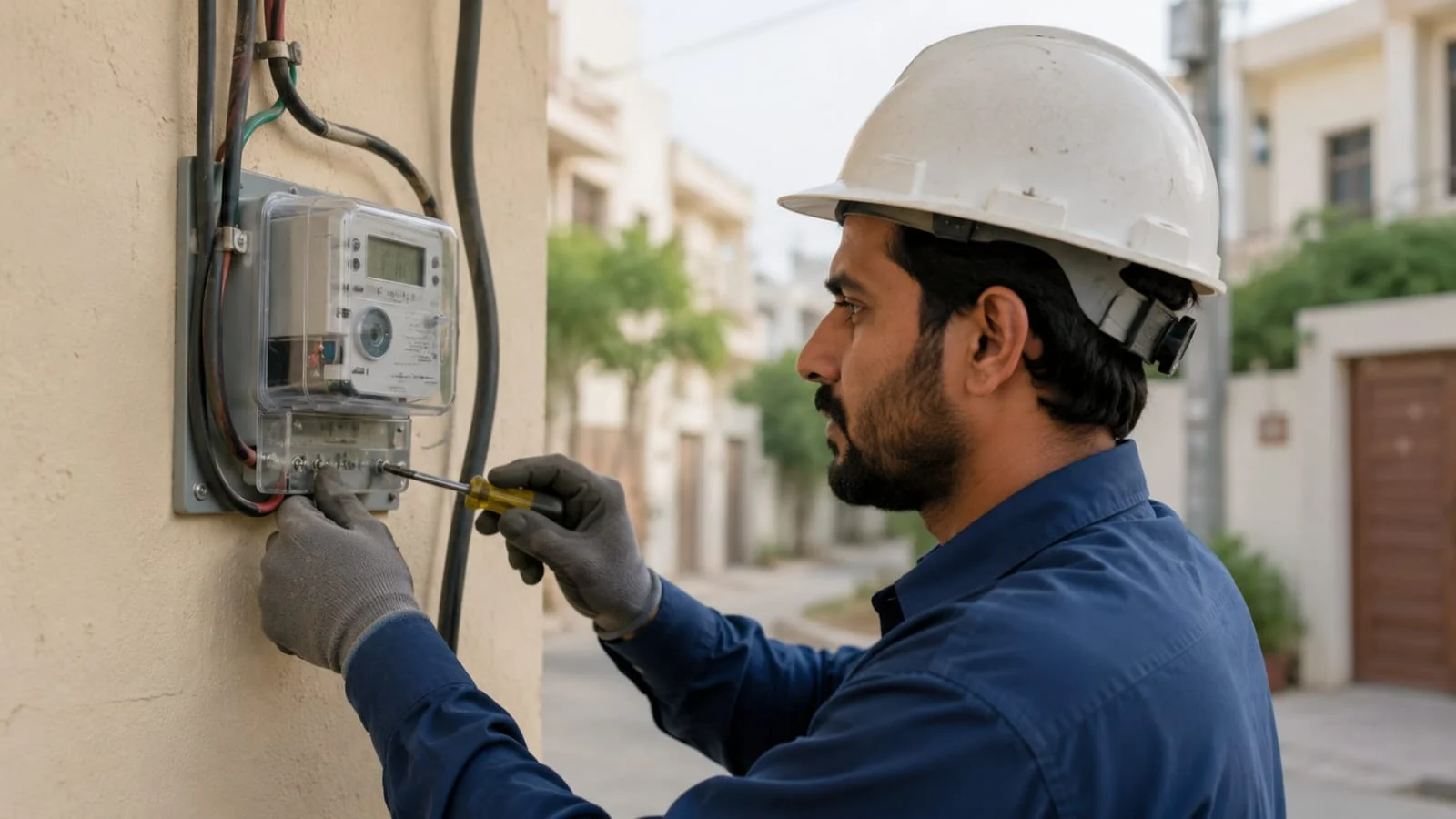
HESCO New Meter Charges 2026: Complete Fee & Demand Notice Guide
Last updated: 13 June 2026 · By Amir Hanif
HESCO new meter charges in 2026 start at Rs.3,000 for a single-phase domestic connection, paid as Rs.300 at the time of connection and the remaining Rs.2,700 in nine monthly installments. On top of this, the demand notice adds a refundable security deposit (around Rs.1,620 per kW in urban areas and Rs.850 per kW in rural areas) plus any service-line and material costs based on your distance from the nearest pole.
If you are building a new home, opening a shop, or shifting to a new property anywhere in the Hyderabad Electric Supply Company (HESCO) region, getting a new electricity meter is one of the first things on your list. The good news is that the process is more transparent than ever, but the total cost can still confuse first-time applicants. Between the connection fee, security deposit, meter price, and service-line charges, the final figure on your demand notice rarely matches the “base” number people quote online.
This guide breaks down every charge in plain English so you can budget correctly, avoid surprise costs, and apply with confidence. We have based the numbers on HESCO’s published connection structure and NEPRA’s regulatory framework, and we explain exactly what each line item means.
What Are HESCO New Meter Charges?
HESCO new meter charges are the combined fees a consumer pays to get a fresh electricity connection installed at their premises. These charges are not a single flat amount. Instead, they are bundled together in an official document called a demand notice, which HESCO issues after verifying your documents and conducting a site survey.
A typical HESCO demand notice includes the following components:
- Connection charges – the basic fee for processing and energizing your new meter.
- Security deposit – a refundable amount calculated on your sanctioned load (kW).
- Meter cost – the price of the physical single-phase or three-phase meter.
- Service-line charges – the cost of cable and labor based on the distance from the nearest HESCO pole.
- Material costs – LT poles, brackets, and hardware if your location is far from the existing grid.
Because the last three items depend on your specific location and load, two neighbors can receive slightly different demand notices. That is completely normal.
HESCO New Meter Charges 2026 (Quick Reference Table)
Here is a clear, at-a-glance breakdown of the main HESCO new connection charges for 2026. These are indicative figures based on HESCO’s standard domestic structure; your final demand notice may vary with load, cable length, and meter type.
| Charge Type | Single-Phase (Domestic) | Three-Phase / Commercial |
|---|---|---|
| Connection charges | Rs.3,000 (Rs.300 + 9 × Rs.300) | Higher, load-based |
| Security deposit (urban) | ~Rs.1,620 per kW | Higher per kW |
| Security deposit (rural) | ~Rs.850 per kW | Higher per kW |
| Service line (standard) | Included up to ~40 m | Variable |
| Extra cable beyond 40 m | ~Rs.200 per extra meter | ~Rs.200+ per extra meter |
| Installation time | 15–30 days | 30–60 days |
HESCO Single-Phase Meter Charges Explained
A single-phase connection is the most common choice for ordinary homes, flats, and small residential units. For new domestic single-phase meters, HESCO sets the connection charge at Rs.3,000. To make this affordable, HESCO splits it into two parts:
- Rs.300 recovered at the time of connection, and
- Rs.2,700 recovered in nine equal monthly installments of Rs.300 each, added to your subsequent bills.
This installment facility is optional and is provided only to consumers who specifically request it in writing. If you prefer, you can pay the full amount at once.
On top of the connection charge, your standard service line is typically covered up to about 40 meters. If the distance from the nearest pole to your premises is longer, roughly Rs.200 is added for each additional meter of cable required.
HESCO Three-Phase Meter Charges
A three-phase connection is designed for larger homes (especially those running multiple air conditioners), shops with heavy load, offices, and small industrial units. Three-phase charges are higher than single-phase because:
- The three-phase meter itself costs more than a single-phase unit.
- The sanctioned load is larger, which raises the security deposit (calculated per kW).
- Heavier cable and additional material are often required for load balancing.
If you are unsure whether you need single-phase or three-phase, a simple rule helps: homes with two or more ACs, or any premises with motors and heavy machinery, usually need three-phase. HESCO’s site survey team will confirm the correct category during inspection.
HESCO Security Deposit: How It Is Calculated
The security deposit is one of the most misunderstood parts of the demand notice. It is a refundable amount, not a fee — HESCO holds it as a guarantee against unpaid bills and returns it when you permanently disconnect the meter.
For domestic Tariff A-1 connections, the security deposit is calculated per kilowatt (kW) of sanctioned load:
| Area | Security Deposit Rate |
|---|---|
| Urban | ~Rs.1,620 per kW |
| Rural | ~Rs.850 per kW |
For example, a 2 kW urban home would pay roughly Rs.3,240 as security deposit (2 × Rs.1,620). Commercial and industrial categories have higher per-kW rates because their consumption and risk profile are greater.
What Is a HESCO Demand Notice?
A demand notice is the official payment voucher HESCO issues to a new applicant. Think of it as the final invoice for your connection. It is generated only after:
- Your application is submitted with all required documents.
- A HESCO survey team verifies your address and assesses the load.
- The exact service-line distance and material requirements are calculated.
The demand notice itemizes every cost — connection charges, security deposit, meter cost, and service-line fees — into one payable amount. You must pay it at a designated bank within the time limit printed on the notice. Your application cannot move forward until the demand notice is cleared, so treat it like a final bill.
Documents Required for a HESCO New Meter
Having the right paperwork ready is the single biggest factor in avoiding delays. Prepare these before you apply:
- Copy of your CNIC (Computerized National Identity Card)
- Proof of ownership — registry or sale deed
- A neighbor’s recent electricity bill (for reference and feeder details)
- Wiring test report from a licensed electrician
- Two passport-size photographs
- Signed undertaking confirming no existing meter or outstanding dues on the premises
If the property has multiple owners, an attested power of attorney in favor of the applicant is also required.
Step-by-Step: How to Apply for a HESCO New Meter
Step 1 — Submit Your Application
Apply online through the official ENC (Electricity New Connection) system, or visit your nearest HESCO sub-division office. Fill in the new connection form accurately.
Step 2 — Upload or Submit Documents
Attach scanned copies of all required documents. Incomplete applications are the most common reason for rejection.
Step 3 — Site Survey & Demand Notice
A HESCO team inspects your premises, assesses load and distance, then issues your demand notice with the full cost breakdown.
Step 4 — Pay the Demand Notice
Pay the total amount at the designated bank before the deadline. Keep the paid receipt safe.
Step 5 — Verification & Meter Installation
After payment is verified, HESCO installs your meter and energizes the connection. Single-phase installation typically completes in 15–30 days; three-phase in 30–60 days.
Why HESCO New Meter Charges Vary by Location
One reason quoted prices differ so much online is that HESCO charges are partly location-dependent. The fixed components (connection charge and meter cost) are uniform, but the variable components are not. These include:
- Service-line distance — more cable means higher cost.
- LT poles and hardware — charged at current HESCO store rates if you are far from the grid.
- Urban vs rural classification — directly changes the per-kW security deposit.
HESCO operates across a wide area of Sindh, including Hyderabad, Jamshoro, Thatta, Badin, Matiari, Tando Allahyar, Tando Muhammad Khan, Sujawal, Dadu, Mirpurkhas, Tharparkar, Umerkot, and Sanghar. A connection in a dense urban neighborhood will differ from one in a remote rural feeder — which is exactly why the demand notice is calculated individually.
💡 Expert Tip from the Field
Before applying, walk the distance from the nearest HESCO pole to your meter board and note it. Service-line cost is the biggest “hidden” variable in any demand notice. Knowing your approximate distance lets you estimate the extra cable charge in advance and avoids the shock of an inflated notice.
Common Problems and How to Solve Them
Application Rejected
Cause: missing or mismatched documents. Fix: double-check every requirement, especially the wiring test report and ownership proof, before submitting.
Delay in Installation
Cause: workload or technical backlog. Fix: follow up at your sub-division office using your tracking ID.
Incorrect Demand Notice Amount
Cause: wrong load or distance entry. Fix: request a correction before paying — once paid, adjustments are far harder.
HESCO New Meter Charges vs Other DISCOs
HESCO’s structure is broadly similar to other Pakistani distribution companies (DISCOs) such as LESCO, IESCO, MEPCO, FESCO, GEPCO, PESCO, SEPCO, and QESCO, since all operate under NEPRA. The single-phase connection fee, installment facility, and per-kW security deposit logic follow the same national framework. The main differences come from regional service-line rates and local material costs. So if you have applied with another DISCO before, the HESCO process will feel familiar.
🔑 Key Takeaways
- HESCO single-phase new meter connection charge is Rs.3,000 (Rs.300 upfront + 9 monthly installments of Rs.300).
- Security deposit is refundable: ~Rs.1,620/kW urban, ~Rs.850/kW rural for domestic A-1.
- The demand notice bundles connection, deposit, meter, and service-line costs into one payable voucher.
- Standard service line covers ~40 m; extra cable adds roughly Rs.200 per meter.
- Three-phase costs more due to a bigger meter, higher load, and heavier material.
- Installation takes 15–30 days (single-phase) or 30–60 days (three-phase).
- You can apply, track, and pay entirely online via the ENC portal.
Frequently Asked Questions
What are HESCO new meter charges in 2026?
How much is the HESCO security deposit per kW?
What is a HESCO demand notice?
How long does HESCO take to install a new meter?
Are HESCO three-phase meter charges higher than single-phase?
Can I apply for a HESCO new meter online?
Is the HESCO security deposit refundable?
Already Have a HESCO Connection?
Check your latest electricity bill, view your due date, and download a duplicate copy in seconds — no login required.
Check Your HESCO Bill Online →Disclaimer: Charges are indicative and subject to revision by HESCO and NEPRA. Your final demand notice may differ based on load, cable length, and site conditions. Always confirm the exact amount on your official HESCO demand notice. For authoritative details, refer to the official HESCO website and NEPRA.