HESCO Bill History: How to View, Check & Download Past Electricity Bills
Access your complete HESCO billing records — past due amounts, meter readings, tariff history, and downloadable duplicate bills — all explained in one place.
Check Your HESCO Bill Now →- HESCO was established in 1998 and serves over 3 million consumers across Sindh, Pakistan.
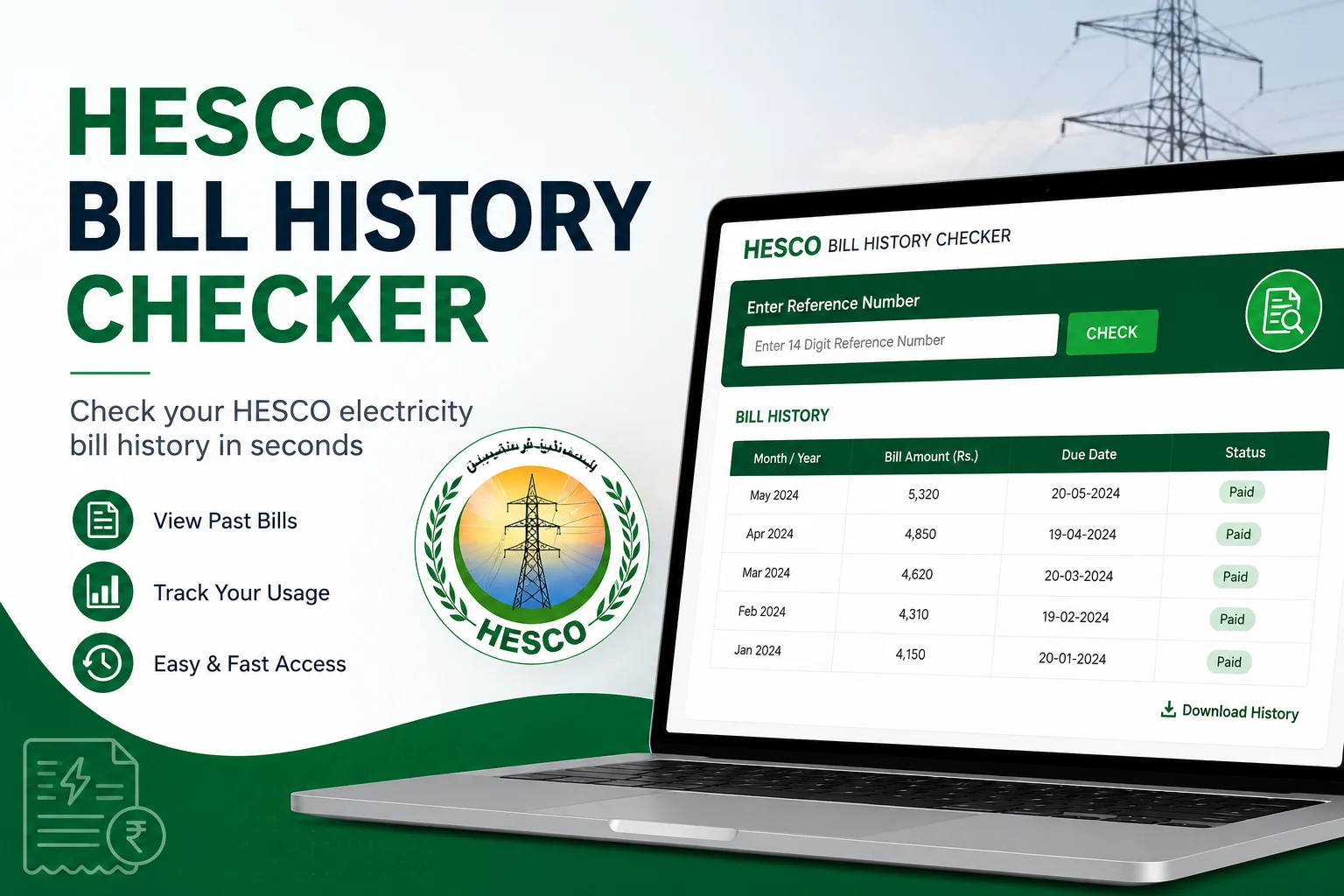
- Check HESCO bill history using your 14-digit reference number — no account needed.
- Records show monthly consumption, arrears, meter readings, taxes, and surcharges.
- Duplicate bills for past months can be downloaded free of charge online.
- HESCO follows NEPRA-regulated tariffs covering residential, commercial, industrial, and agricultural categories.
- Bill history is essential for disputes, visa applications, FBR filings, and rental agreements.
What Is HESCO Bill History?
Your HESCO bill history is a complete record of every electricity bill ever issued to your connection by the Hyderabad Electric Supply Company. It includes monthly billing statements showing consumption, charges, taxes, arrears, and payment records since your meter was installed.
For consumers across Hyderabad, Sukkur, Mirpurkhas, and other areas of Sindh, this billing history is the primary financial paper trail for household and business energy usage. It is needed for billing disputes, government filings, loan applications, visa paperwork, and tracking how energy costs have changed over time.
A Brief History of HESCO: From WAPDA to Independent Utility
WAPDA Era — Before 1998
WAPDA (Water and Power Development Authority), established in 1958, managed all electricity generation and distribution across Pakistan for decades. Consumers in Hyderabad received bills directly from WAPDA — all manual, all paper-based, with no online access and no standardized reference number system.
HESCO’s Formation — 1998
In 1998, the Government of Pakistan launched a major power sector restructuring program, splitting WAPDA’s distribution network into several independent DISCOs (Distribution Companies). HESCO was established in 1998, taking over electricity distribution for Hyderabad Division and surrounding Sindh districts, regulated by the newly formed NEPRA.
This created the modern HESCO billing system — unique consumer reference numbers, standardized billing cycles, and formal consumer record-keeping.
Digital Billing — 2000s to 2010s
HESCO gradually computerized billing through the 2000s. The 14-digit reference number system became the unique consumer identifier. The PITC (Pakistan Information Technology Company) platform enabled online bill access for the first time, allowing consumers to view bills at bill.pitc.com.pk without visiting any office.
Mobile & Online Era — 2015 to Present
From 2015 onward, dedicated portals like hescobillsonline.com made bill checking instant on any smartphone. SMS alerts and email subscriptions launched. Today, millions of HESCO consumers check bills the moment they are generated — without waiting for a paper copy.
Did You Know?
HESCO serves over 3 million consumers across Hyderabad, Sukkur, Larkana, Mirpurkhas, Nawabshah, and Thatta divisions — one of Pakistan’s largest electricity distribution companies by geographic coverage.
What’s Inside Your HESCO Bill History
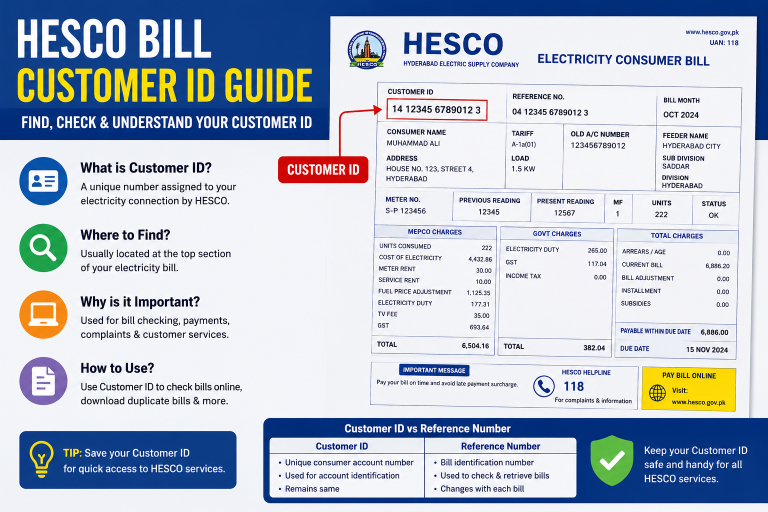
Every HESCO billing statement — current or historical — contains these standardized components:
| Bill Component | What It Means | Where to Find It |
|---|---|---|
| Reference Number | Your 14-digit unique consumer ID | Top of every bill |
| Current Month Units | Electricity consumed in the billing period (kWh) | Meter reading section |
| Previous Meter Reading | Reading at start of billing period | Meter details |
| Present Meter Reading | Reading at end of billing period | Meter details |
| Bill Amount | Total payable before due date | Payment summary |
| Due Date | Last day to pay without surcharge | Payment summary |
| After Due Date Amount | Amount if paid late (includes surcharge) | Payment summary |
| Arrears | Unpaid balance carried from previous months | Charges breakdown |
| GST & Taxes | General Sales Tax, FCA, PTV fee, Electricity Duty | Tax & duty section |
| Consumer Category | Residential, commercial, industrial, agricultural | Consumer info section |
How to Check HESCO Bill History Online Step-by-Step
Why Your HESCO Bill History Matters
- Billing disputes: Past records prove your typical consumption pattern and help identify overcharging or meter errors.
- FBR tax filings: Businesses and freelancers need recent utility bills as proof of address for Federal Board of Revenue documentation.
- Rental agreements: Landlords and tenants review billing history to estimate electricity costs before signing leases.
- Bank loan applications: Banks require recent utility bills for address verification during loan and mortgage processing.
- Visa applications: Most embassies require utility bills as proof of Pakistani residence for visa approval.
- Energy audits: Reviewing 6–12 months of bills reveals seasonal spikes and efficiency improvement opportunities.
- Arrears management: Confirms exactly which months had unpaid balances and when they were cleared.
HESCO Tariff History: How Electricity Rates Changed Over the Years
When comparing HESCO bill history across years, the single biggest factor behind rising bills is tariff escalation. HESCO follows rates approved by NEPRA, which have risen significantly since 2010.
| Period | Approx. Rate (per unit) | Key Driver |
|---|---|---|
| 2010–2013 | Rs. 5–8 | Stable base tariff, low fuel charges |
| 2014–2016 | Rs. 8–12 | Circular debt adjustments begin |
| 2017–2019 | Rs. 12–16 | Fuel Cost Adjustments (FCA) regularized |
| 2020–2022 | Rs. 16–22 | COVID import cost impact |
| 2023–2024 | Rs. 22–35 | IMF conditions, tariff rationalization |
| 2025–2026 | Rs. 35–50+ (slab-dependent) | Capacity payments, revised FCA |
Frequently Asked Questions
Ready to Check Your HESCO Bill?
View current bills, access past records, and download duplicate copies — free, instant, on any device.
Check My HESCO Bill Now →