HESCO Bill July Taxes: A Plain-English Guide to Every Charge
If your HESCO electricity bill looks bigger than usual this July, you’re not imagining it. Here’s exactly what’s on it, why it’s there, and what you can actually do about it.
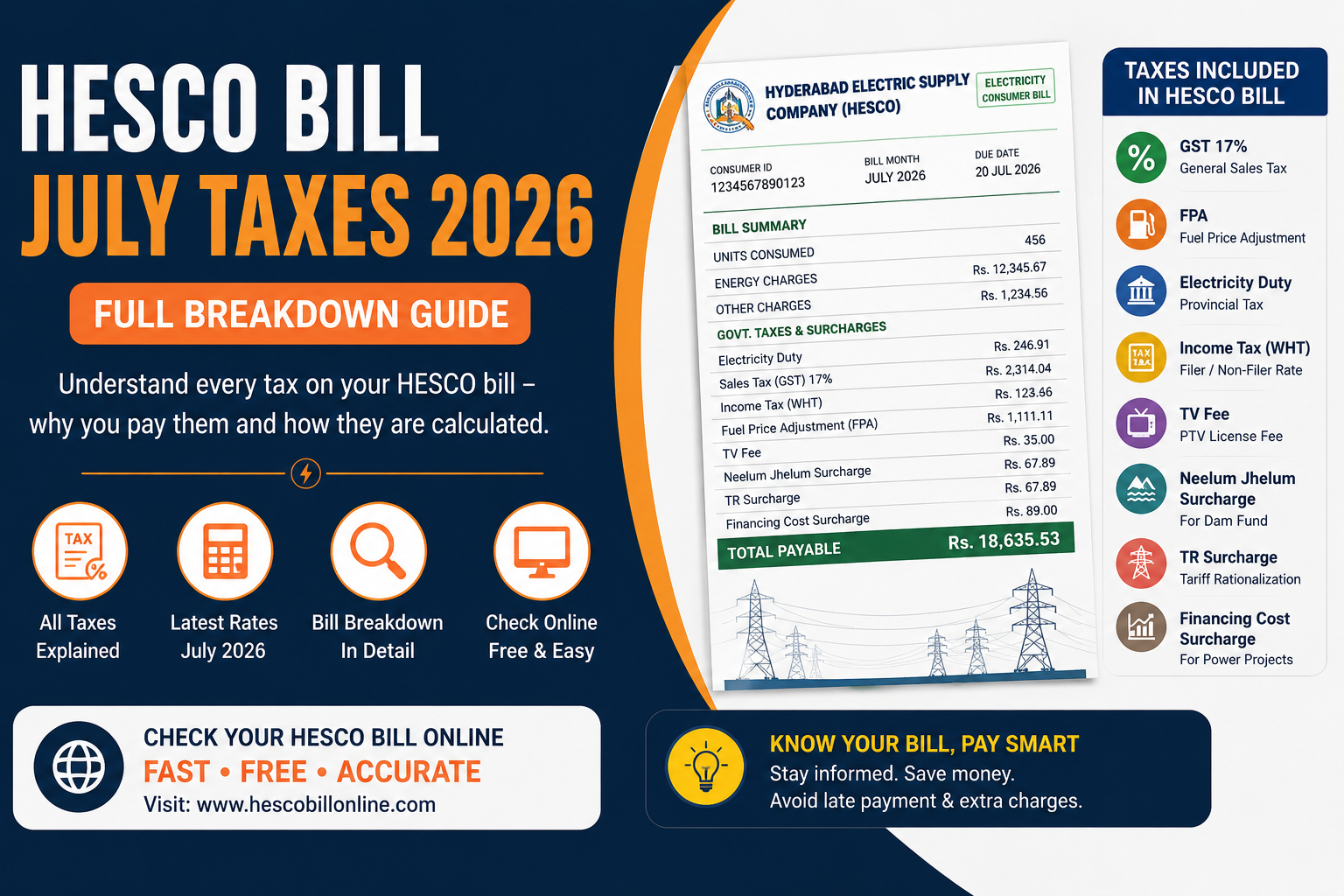
Short answer: A HESCO bill for July carries roughly nine possible charges on top of your raw electricity cost — General Sales Tax (17%), Fuel Price Adjustment, Electricity Duty, Income/Withholding Tax, PTV Fee, TR Surcharge, Neelum Jhelum Surcharge, Financing Cost Surcharge, and a Late Payment Surcharge if you miss the due date. Most of these are set by federal or provincial law, not by HESCO itself, which is why the same tax categories show up on LESCO, MEPCO, FESCO, and every other DISCO bill in Pakistan too.
Every summer, the same question lands in HESCO customer support inboxes across Hyderabad, Sukkur, Nawabshah, Mirpurkhas, and Larkana: “My units barely changed, so why did my bill jump so much?” The honest answer is that the taxes on your bill scale with the amount you’re billed, and July is one of the two or three months a year when that base amount tends to climb fastest. This guide walks through every line item on a HESCO bill, explains where each one comes from, and shows you how to check your own bill’s breakdown in under a minute.
Why Does a HESCO Bill Jump So Much in July?
Three things happen at once in July, and together they make the bill feel heavier than it did in March or November.
First, cooling load goes up. Air conditioners, ceiling fans, and refrigerators run for more hours a day, so household consumption in units (kWh) climbs. Second, HESCO — like every Distribution Company (DISCO) regulated by NEPRA (the National Electric Power Regulatory Authority) — bills electricity on a slab system, where each additional block of units is charged at a higher per-unit rate. Cross into a higher slab and your average cost per unit rises, not just your total units. Third, because GST, electricity duty, and a few other charges are calculated as a percentage of the bill amount, a bigger base bill automatically produces bigger tax figures, even though the tax rate itself hasn’t changed.
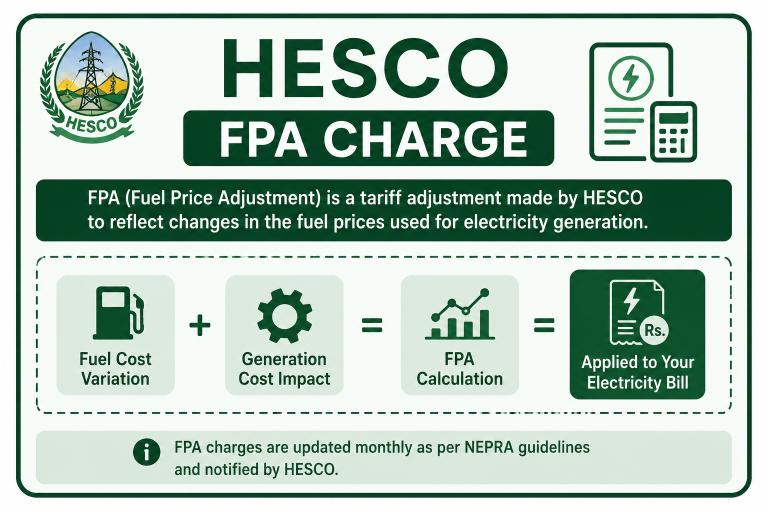
There’s also a monthly variable called the Fuel Price Adjustment, which NEPRA notifies separately based on the previous month’s actual fuel cost for power generation. When furnace oil, LNG, or coal prices move, or when the rupee weakens against the dollar for imported fuel, that cost gets passed through to consumers on a lag — and July often carries the adjustment for June’s higher-demand generation mix.
Complete Breakdown: Every Tax and Surcharge on a HESCO Bill
Here’s the full list of charges you might see on a July HESCO bill, what they’re for, and who actually collects the money — because it’s rarely HESCO itself.
| Charge | Typical Rate | Collected By |
|---|---|---|
| General Sales Tax (GST) | 17% of the billed amount | Federal Board of Revenue (FBR) |
| Fuel Price Adjustment (FPA) | Set monthly by NEPRA, variable | NEPRA / Power Division |
| Electricity Duty | Around 1.5% of the billed amount | Government of Sindh |
| Income Tax / Withholding Tax | Depends on filer status and bill size | Federal Board of Revenue (FBR) |
| PTV Fee | Fixed, roughly Rs. 35/month (domestic) | Pakistan Television |
| TR Surcharge | Small fixed or variable amount | Power Division |
| Neelum Jhelum Surcharge | Fixed per-unit charge | Power Division |
| Financing Cost Surcharge (FCS) | Variable, revised periodically | Power Division |
| Late Payment Surcharge | Around 10% if paid after due date | HESCO |
Not everyone sees every charge. A domestic consumer on a small connection may never see certain industrial or commercial line items, and PTV Fee typically applies only to residential connections. Your exact list depends on your tariff category and sanctioned load.
General Sales Tax (GST): The Biggest Single Line Item
GST at 17% is applied to almost every domestic and commercial electricity bill in Pakistan under federal tax law. It’s calculated on the total electricity charge before most other surcharges, which is why it usually makes up the single largest tax component on the bill. HESCO doesn’t set this rate and can’t waive it — it’s identical across LESCO, FESCO, MEPCO, GEPCO, PESCO, and every other DISCO.
Fuel Price Adjustment (FPA): Why It Changes Every Month
FPA exists because the actual cost of generating electricity shifts month to month depending on the fuel mix — hydel, thermal, imported LNG, furnace oil, or coal — and on currency movement for anything imported. NEPRA reviews and notifies this adjustment separately from the base tariff, so it can push your bill up or down independent of how many units you used. A positive FPA in a summer month, when thermal generation typically covers more of the peak demand, is one of the more common reasons a July bill feels heavier than a January one.
Electricity Duty: The Provincial Share
Electricity Duty is levied by the Government of Sindh on every consumer inside HESCO’s service territory. It’s a separate line from federal GST and funds provincial administrative and development costs tied to the power sector. It’s typically a smaller percentage than GST but still adds up on a large bill.
Income Tax: The Filer vs Non-Filer Gap
Once a bill crosses a certain threshold, Pakistani tax law requires withholding income tax to be deducted at source through the electricity bill. The rate an active FBR taxpayer (a “filer”) pays is meaningfully lower than what a non-filer pays on an identical bill amount. This is one of the few tax components a consumer can directly influence — becoming an active filer is the standard, legal way to bring this figure down.
PTV Fee, TR Surcharge, Neelum Jhelum Surcharge, and FCS
These four are smaller, mostly fixed charges that rarely change month to month:
- PTV Fee funds Pakistan Television and is a flat monthly charge on domestic connections.
- TR Surcharge (Temporary Relief) is a small charge set by the Power Division.
- Neelum Jhelum Surcharge is a fixed per-unit charge tied to financing the Neelum-Jhelum Hydropower Project.
- Financing Cost Surcharge (FCS) covers the cost of financing the power sector’s circular debt and is revised periodically by the Power Division.
None of these move much with your consumption, so they’re usually the most predictable part of your bill from month to month.
How the Slab System Multiplies Your Tax Amount
Because several taxes are percentage-based, understanding the slab system explains a lot about why July bills feel disproportionately higher than the increase in units alone would suggest. NEPRA’s tariff structure charges progressively higher rates as consumption rises past defined thresholds. Cross from, say, a 300-unit slab into a 500-unit slab, and every unit in that higher band costs more per unit — which lifts your energy charge, which then lifts GST and electricity duty proportionally, since both are calculated as a percentage of that larger base.
In practice, this means a 20% jump in units consumed can translate into a 25–30% jump in the final payable amount once slab pricing and percentage-based taxes compound.
July vs a Typical Winter Month: A Side-by-Side Look
| Factor | July (Peak Summer) | January (Off-Peak) |
|---|---|---|
| Average units consumed | Higher — AC, fans, fridges run longer | Lower — minimal cooling load |
| Tariff slab | Often pushed into a higher slab | Usually stays in a lower slab |
| GST amount | Higher (17% of a larger base) | Lower (17% of a smaller base) |
| FPA impact | Can be significant during high-demand months | Typically a smaller adjustment |
| Overall bill | Noticeably heavier | More manageable |
How to Check Your HESCO Bill and Tax Breakdown Online
You don’t need to queue at a HESCO office to see the exact math behind your bill. Using HESCO Bill Online, you can pull up your full July bill in under a minute:
- Open the HESCO Bill Online homepage.
- Type in your 14-digit reference number or Customer ID in the bill checker box.
- Tap “Check Bill” and let it fetch live data from the official billing server.
- Tap “Open My Bill” to see the complete breakdown — GST, FPA, electricity duty, income tax, and every surcharge listed separately.
- Save or print it as a PDF for your records or for paying at a bank counter.
Not sure where your reference number is? The HESCO Reference Number guide shows exactly where to find the 14-digit code on any past bill.
Practical Ways to Lower the Tax You Pay Each Month
You can’t opt out of GST or electricity duty — they’re federal and provincial law. But you can shrink the base amount those percentages are calculated on, and you can avoid the charges that are entirely within your control:
- Become an active FBR filer. This is the single biggest lever you have over the income tax portion of your bill.
- Stay under the next tariff slab where possible. Shifting even 20–30 units of usage can keep you out of a higher per-unit rate.
- Switch high-draw appliances to efficient ones. Inverter ACs and LED lighting cut consumption meaningfully during peak summer months.
- Pay before the due date. The roughly 10% late payment surcharge is avoidable and adds nothing to your service.
- Review your bill every month. Sudden spikes are sometimes billing or meter errors, not real consumption — catching them early saves money.
Is HESCO’s Tax Structure Different From Other DISCOs?
Not really. GST, electricity duty, income tax, PTV Fee, and FPA follow national or provincial policy and apply in essentially the same way across HESCO, LESCO, MEPCO, FESCO, GEPCO, PESCO, and the rest of Pakistan’s Distribution Companies operating under NEPRA. What differs between DISCOs is the tariff rate for each category and the regional generation/fuel mix — not the categories of tax themselves. So if you’ve ever compared notes with a friend on LESCO or FESCO, the tax lines on their bill will look almost identical to yours; only the numbers differ.
Key Takeaways
- A HESCO July bill can include up to nine separate taxes and surcharges, led by 17% GST and a monthly Fuel Price Adjustment.
- July bills run higher mainly because summer usage pushes many households into a higher tariff slab, which then inflates every percentage-based tax on top of it.
- Active FBR filers pay a lower withholding tax rate than non-filers on an identical bill.
- Most tax categories are set by federal or provincial law and are identical across all Pakistani DISCOs — HESCO can’t adjust them independently.
- You can view your complete bill and its tax breakdown online in under a minute using your 14-digit reference number.
- Paying on time avoids the roughly 10% late payment surcharge entirely.
Frequently Asked Questions
Why is my HESCO bill higher in July than other months?
Summer cooling pushes consumption into a higher tariff slab, and because GST, electricity duty, and other charges are percentage-based, a larger base bill automatically produces larger tax amounts on top of it.
What exact taxes appear on a HESCO bill?
A typical HESCO bill can include GST, Fuel Price Adjustment, Electricity Duty, Income/Withholding Tax, PTV Fee, TR Surcharge, Neelum Jhelum Surcharge, and Financing Cost Surcharge, plus a Late Payment Surcharge if paid after the due date.
Is GST really charged on every single HESCO bill?
Yes, GST at 17% applies to nearly all domestic and commercial HESCO bills under federal tax law, with exemptions limited to specific categories defined by the FBR.
How can I pay less income tax on my electricity bill?
Register as an active taxpayer with the FBR. Filers are charged a lower withholding tax rate than non-filers on the same bill amount, and it’s the main legal way to reduce this specific charge.
Where can I see my July HESCO bill’s tax breakdown online?
Enter your 14-digit reference number on HESCO Bill Online to view the complete bill with every tax and surcharge itemized separately.
Does the Fuel Price Adjustment ever lower my bill?
Yes. FPA can move in either direction depending on fuel costs and currency movement for the relevant month — it isn’t always an increase, even though it tends to run higher during peak summer generation months.
Final Word: Understand It Once, Read Every Bill With Confidence
None of the charges on a HESCO bill are arbitrary — each one traces back to a federal law, a provincial tax, or a specific infrastructure project. Once you know what GST, FPA, electricity duty, and the smaller surcharges actually represent, a July bill stops looking like a mystery and starts looking like a list you can check line by line. The one habit worth building is checking your bill online every month before it’s due, both to confirm the numbers and to catch anything that looks off early.
Check Your July HESCO Bill in Seconds
See your exact GST, FPA, and electricity duty breakdown — free, online, no office visit needed.
Check My Bill Now