HESCO FPA Charge Explained: What It Means and Why It’s on Your Bill
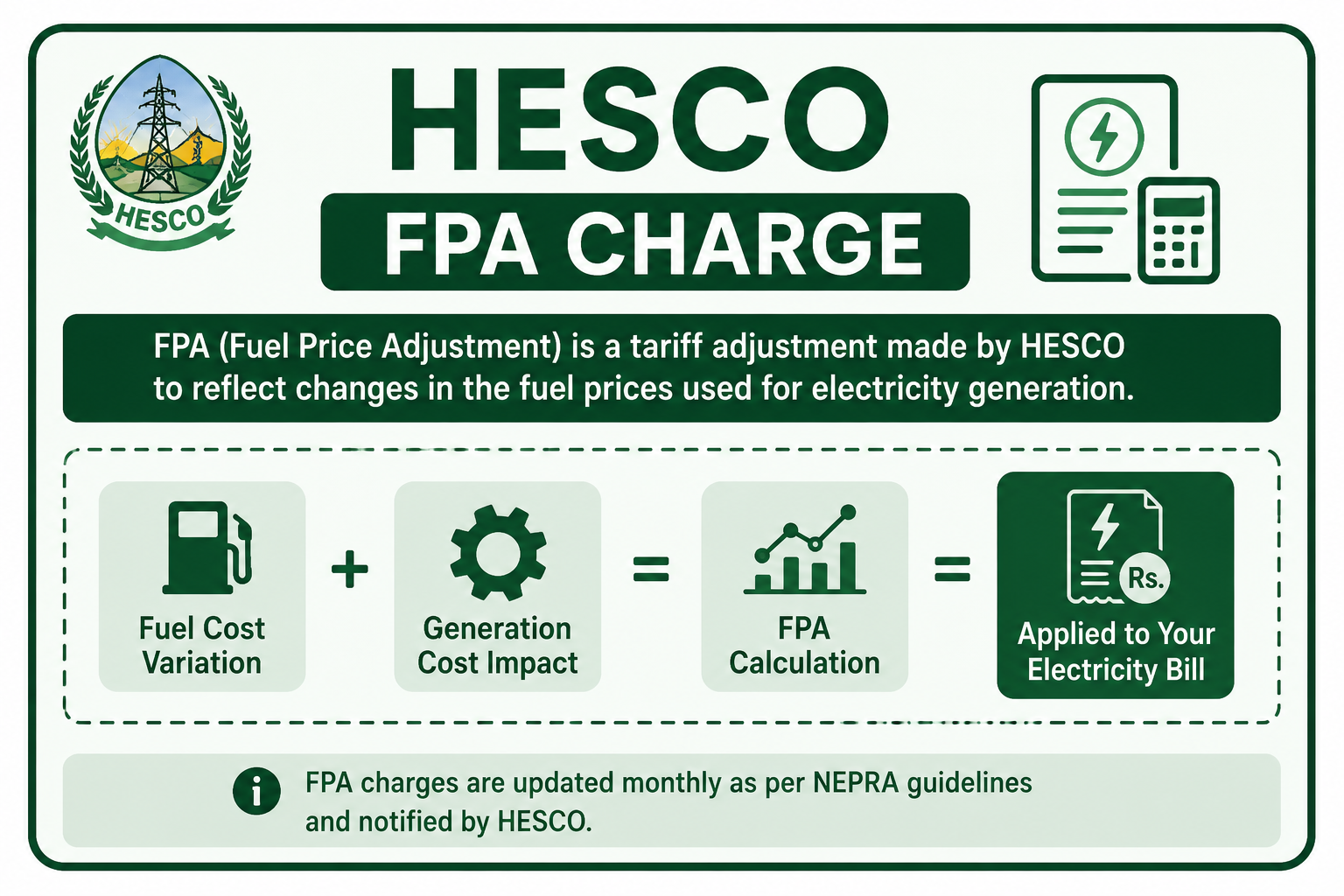
If you’ve looked closely at your electricity bill and spotted a line called “FPA Charge,” you’re not alone in wondering what it is. In short, the HESCO FPA charge (Fuel Price Adjustment) is an extra amount added to or subtracted from your bill based on changes in fuel prices used to generate electricity. It’s not a fixed fee — it moves up or down every month depending on national fuel costs. Below, we break down exactly how it works, how it’s calculated, and how to check it for your own HESCO bill online.
What Is the HESCO FPA Charge?
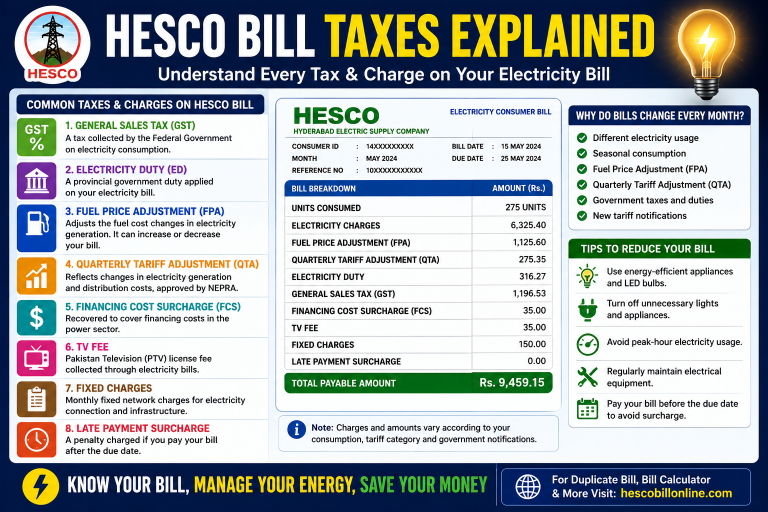
HESCO, or the Hyderabad Electric Supply Company, is one of Pakistan’s main power distribution companies serving Hyderabad, Sukkur, and nearby districts of Sindh. Like other DISCOs (K-Electric, LESCO, MEPCO, etc.), HESCO doesn’t set its own electricity tariffs. Instead, the base tariff is fixed by NEPRA (National Electric Power Regulatory Authority), and monthly adjustments — like the FPA — are added separately to reflect real-world changes in fuel costs.
FPA stands for Fuel Price Adjustment. It exists because the cost of generating electricity depends heavily on fuel types such as furnace oil, gas, coal, and imported LNG. These prices fluctuate constantly due to international markets, currency exchange rates, and supply conditions. Since the base electricity tariff is fixed for months at a time, the FPA charge acts as a “correction” — either adding a small amount if fuel costs rose, or subtracting an amount if fuel costs fell.
Why Does HESCO Add This Charge Separately?
Instead of changing the entire tariff structure every month, NEPRA allows a simpler system: keep the base rate steady, and adjust only the fuel-related portion. This approach is more transparent because customers can clearly see how much of their bill is due to fuel cost changes versus the fixed cost of electricity distribution.
How Is the FPA Charge Calculated?
The FPA charge is calculated centrally by NEPRA based on data submitted by CPPA-G (Central Power Purchasing Agency), not by HESCO itself. Here’s the general process:
- CPPA-G calculates the actual average fuel cost used to generate electricity for a given month.
- This actual cost is compared to the fuel cost already built into the base reference tariff.
- The difference (positive or negative) becomes the FPA rate per unit (per kWh).
- NEPRA reviews and approves this adjustment.
- HESCO then applies the approved rate to customer bills, usually with a lag of one to two months.
Does the FPA Charge Apply to Every Customer?
Yes, in most cases it applies to almost all consumer categories — residential, commercial, and industrial — though lifeline consumers (very low electricity users) are sometimes partially or fully exempted, depending on government policy at the time. It’s always best to check your latest bill or verify directly through HESCO Bill Online for your exact charge.
FPA Charge vs Other Bill Adjustments
Many customers confuse FPA with other charges on their bill, such as Quarterly Tariff Adjustment (QTA) or Fixed Charges. Here’s a simple comparison table to clear things up:
| Charge Type | Purpose | Frequency |
|---|---|---|
| FPA (Fuel Price Adjustment) | Reflects changes in fuel cost for generation | Monthly |
| QTA (Quarterly Tariff Adjustment) | Adjusts for overall generation cost variance | Quarterly |
| Fixed Charges | Covers grid maintenance & infrastructure | Monthly, fixed amount |
| TV Fee / Electricity Duty | Government-mandated levies | Monthly |
How to Check Your HESCO FPA Charge Online
Checking your FPA charge doesn’t require a visit to the HESCO office. You can view your complete, itemized bill — including the FPA line — instantly online. Here’s how:
- Visit hescobillsonline.com
- Enter your 14-digit reference number found on any previous bill
- Click “Check Bill” to view your current bill breakdown
- Look for the “FPA” or “Fuel Adjustment” line in the charges section
This method is fast, free, and available 24/7, making it especially useful if you’ve misplaced your paper bill or want to double-check charges before payment.
Why FPA Charges Change Every Month
Pakistan imports a significant portion of its fuel for power generation, including furnace oil and LNG. This means:
- Global oil and gas price shifts directly affect the FPA rate.
- Currency depreciation (PKR vs USD) can raise import costs, increasing FPA.
- Higher use of cheaper local fuel (like hydel or coal) in a given month can lower FPA.
- Government subsidies or relief packages can temporarily reduce the passed-on cost.
This is why you might notice the FPA charge on your HESCO bill go up one month and down the next — it’s a direct reflection of the national fuel mix and market conditions, not something HESCO controls independently.
Key Takeaways
- The FPA charge is a fuel-cost adjustment, not a hidden fee or penalty.
- It is set by NEPRA/CPPA-G, and HESCO simply applies the approved rate.
- The charge can be positive (added cost) or negative (a credit/discount).
- It typically appears with a one to two month delay relative to actual fuel costs.
- You can verify the exact FPA amount anytime via HESCO Bill Online.
Frequently Asked Questions (FAQs)
Q1: What does FPA mean on a HESCO bill?
FPA stands for Fuel Price Adjustment — a variable charge reflecting the real cost of fuel used to generate electricity that month.
Q2: Is the FPA charge fixed every month?
No. It changes monthly based on fuel prices, currency rates, and generation mix, and is approved by NEPRA.
Q3: Can the FPA charge be negative?
Yes. If fuel costs fall below the reference tariff level, customers may receive a negative FPA, effectively reducing their bill.
Q4: Does HESCO decide the FPA rate on its own?
No. HESCO applies the rate determined by NEPRA based on data from CPPA-G; it does not set the rate independently.
Q5: How can I check my exact FPA charge?
Visit hescobillsonline.com, enter your reference number, and view your itemized bill instantly.
Q6: Why did my FPA charge increase suddenly?
This usually happens when international fuel prices rise or the rupee depreciates, increasing the cost of imported fuel for power generation.
Expert Insight & Trustworthiness
Understanding utility charges like FPA helps consumers budget better and avoid confusion over “why my bill increased.” As a general rule of thumb from industry observation: FPA charges tend to spike during summer months when generation demand — and therefore fuel consumption — is highest across Pakistan’s national grid. Cross-checking your bill regularly through an official or verified portal is the best way to stay informed and avoid billing disputes.
For official regulatory information, consumers can also refer to NEPRA’s official website and CPPA-G, the two bodies responsible for setting and approving fuel adjustment rates nationwide.
Check Your HESCO Bill & FPA Charge Instantly
Skip the confusion — view your latest bill breakdown online in seconds.
Check My HESCO Bill NowConclusion
The HESCO FPA charge might look confusing at first glance, but it’s simply a reflection of real fuel costs passed on to consumers in a transparent, regulated way. It isn’t controlled by HESCO alone — it’s approved by NEPRA based on national fuel pricing data. The best way to stay on top of it is to check your bill regularly. Head over to HESCO Bill Online today to view your latest bill, confirm your FPA charge, and pay conveniently — all in one place.